Maintenance
Part of Precious-metals storage and records guide
Bullion storage, insurance, and access checklist
Bullion storage checklist covering ownership, custody, physical controls, policy wording, inventory proof, digital privacy, emergency access, and annual review.
What to take away
- Confirm ownership, custody, access, and insurance as separate questions.
- Record exact policy language instead of relying on general assurances.
- Protect proof in a different loss zone from the metal.
- Give emergency access through documented authority, not shared secrets alone.
- Test inventory reconciliation and digital recovery.
Use this checklist when selecting or reviewing a home, bank, or private-vault arrangement. Mark unknown items as unknown, not yes.
Property and ownership
- Each item or lot has a neutral inventory ID.
- Product, quantity, fine content, package, and identifiers are recorded.
- Invoices, payment proof, gifts, and inheritance records are preserved.
- Legal owner and beneficial owner are clear.
- Custody arrangement matches ownership documents.
Physical controls
- Theft, fire, water, coercion, and access interruption were considered.
- Container or facility claims were verified from documentation.
- Home container is installed as instructed and cannot be carried away easily.
- Storage is elevated from likely water paths.
- Keys, codes, and recovery instructions are stored separately.
- Access is limited and logged.
Insurance
- Insurer confirmed bullion, bars, and coins are covered property.
- Scheduled-property or blanket limit is understood.
- Named location and custody conditions match reality.
- Theft, fire, water, flood, transit, and disappearance are addressed.
- Deductible, sublimit, exclusion, and valuation method are recorded.
- Appraisal and proof-of-loss requirements are current.
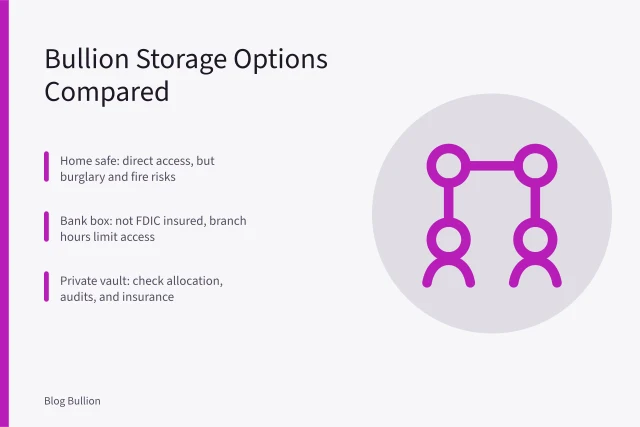
Washington's Office of the Insurance Commissioner writes in its consumer guide to homeowner insurance that it is common for a policy to limit the amount of coverage available for certain types of personal property, listing silver among its examples, and it tells owners to ask the agent or insurer whether those limits need raising. It also advises creating and regularly updating a written inventory of household contents. Ask specifically about precious metals rather than assuming jewelry examples extend to bullion.
Bank or vault contract
- Customer and custodian legal names match records.
- Allocation and item-identification method are defined.
- Customer inspection and audit rights are understood.
- Authorized users and dual-control rules are listed.
- Withdrawal time, form, fees, and delivery responsibility are written.
- Lien, default, branch closure, insolvency, and termination terms were read.
Inventory and privacy
- Exact location is coded in the routine inventory.
- Full location key has a smaller access group.
- Digital file and device are encrypted.
- Strong unique credentials and multifactor authentication are used where available.
- A backup exists in another loss zone.
- Recovery key is not stored with the encrypted backup.
Evidence separation
- A burglary or fire cannot remove both holdings and the only ownership record.
- The insurer can receive invoices and photographs without receiving access secrets.
- The emergency index identifies authorized contacts without listing the full inventory.
- Original documents and working copies have clear roles.
- Old exports, email attachments, and shared links are removed when no longer needed.
Review every copy, not only the master file. A forgotten download on a phone, an unencrypted email attachment, or a printed sheet beside the container can defeat the better controls applied elsewhere. Record who received each sensitive packet, which version it contains, and when it should be returned or destroyed. If a custodian or insurer needs an inventory, ask which fields are required and provide only that version. Keep access codes and account-recovery credentials out of claim evidence.
FDIC guidance on products outside deposit insurance expressly states that safe deposit box contents are not FDIC-insured and recommends checking the rental contract and other insurance. Record the actual policy or endorsement, not the bank's physical security alone.
Emergency and succession
- A designated person knows that a recovery process exists.
- Legal authority is documented for incapacity and death.
- Emergency contact data is current.
- No sole access method depends on a person who may be unavailable.
- Instructions disclose only what the authorized role requires.
Review record
| Review | Date | Reviewer | Evidence checked | Variance | Action due |
|---|---|---|---|---|---|
| Physical count | |||||
| Insurance | |||||
| Access list | |||||
| Backup restore | |||||
| Custodian statement |
Common questions
Is a vault's aggregate policy the same as customer coverage?
No. Ask who is insured, what property qualifies, how limits are shared, and how a customer claims.
Should storage codes be obvious to heirs?
Authorized heirs or fiduciaries need a lawful recovery path, but routine files need not reveal full locations.
What counts as a successful backup test?
Restore a sample to a separate safe location and confirm that it opens with the stored recovery procedure.
When should the checklist be rerun?
After major acquisitions, moves, policy renewals, access changes, household changes, and at least once each year.