Features
Part of Precious-metals storage and records guide
Case study: redesigning household bullion storage
Household bullion storage case showing how one owner separated custody, records, privacy, insurance, emergency access, backups, and recurring inventory reviews.
What to take away
- The original setup placed metal, proof, and access secrets in one loss zone.
- The redesign began with inventory and authority, not a new container.
- Location details were separated from routine ownership records.
- Insurance questions were answered in writing before the move.
- A witnessed count and recovery test closed the project.
This fictional case is an operational example, not a recommendation for a specific container, vault, insurer, or allocation.
Starting condition
Evan kept a small mixed bullion holding in a portable home container. Invoices, the container key, and a printed list sat in the same desk. The list named exact locations but omitted product condition and acquisition references. His spouse knew that metal existed but did not know the insurer, inventory file, or lawful access process.
Four Concentration Risks
- Property and proof share one loss zone
- Portable container can be carried away
- Water can damage paper and packaging
- Emergency access depends on Evan's availability
The setup had four concentration points: property and proof could disappear together, the container could be carried away, water could affect paper and packaging, and an emergency depended on Evan's availability.
FEMA's Emergency Financial First Aid Kit recommends gathering household and financial records, conducting an inventory, protecting copies, and planning access after an emergency. Evan used that general record structure while keeping bullion locations out of the broad household packet.
Redesign requirements
Evan wrote five outcomes:
Five Redesign Outcomes
- Metal and ownership proof in separate loss zones
- Routine inventory hides exact locations
- Authorized spouse can find instructions
- Insurance confirmed for each custody location
- Counts, statements, backups reviewed twice yearly
- Metal and full ownership proof would not share one loss zone.
- Routine inventory would not reveal exact locations.
- An authorized spouse could find instructions without knowing every secret today.
- Insurance treatment would be confirmed for each custody location.
- Counts, statements, and backups would be reviewed twice yearly.
Inventory repair
He assigned neutral lot IDs and added product, quantity, fine content, package, condition, acquisition date, seller, invoice reference, and last verification. Exact storage was replaced with codes. Scanned invoices and photographs went into an encrypted ownership folder.
A separate location key translated codes into places and explained required authority. It did not contain container combinations or account passwords. Those recovery credentials followed their own sealed process.
Custody change
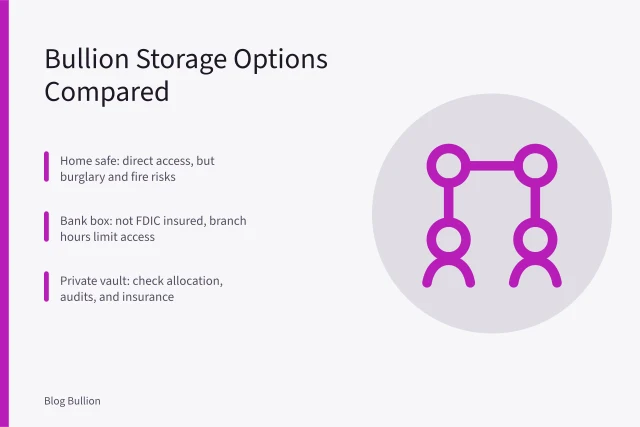
Evan compared continued home storage with a bank box and a private vault. He did not select by door appearance. He compared access hours, legal owner, authorized users, allocation, inventory evidence, withdrawal process, insurance, water exposure, fees, branch or business interruption, and estate handling.
He kept a limited operating amount at home and moved the balance to a second custody location. The case does not claim that split storage is always safer. In his threat model, reducing one-location loss outweighed the added transfer and administration.
Privacy controls
The routine inventory had no street address or bank name. It had no box number, vault account, alarm detail, access code.
NIST defines data minimization as limiting creation, collection, use, storage, and disclosure of personal information to what is relevant and necessary for an authorized purpose. Evan adapted it, giving each record and person only location detail a defined task needs.
Insurance confirmation
He sent the insurer a written description of metal type, approximate value band, home container, second custody arrangement, transit plan, and desired perils. The reply identified the applicable endorsement, deductible, valuation method, documentation, location conditions, and exclusions. He saved the response with the policy.
Transfer and closure
Evan and a witness counted each lot before and after transfer. They recorded dates, from-code, to-code, quantities, package condition, and custodian receipt. The old printed location list was securely destroyed after the new system had been verified.
Finally, his spouse followed the emergency index to locate the insurer, attorney, inventory custodian, and sealed authority instructions. Evan restored a sample backup and confirmed that the recovery key worked. Both signed the review record.
Result
The redesign did not eliminate theft, fire, water, business, or succession risk. It removed several single points of failure and produced a record that another authorized person could follow without broadcasting the holdings.
Common questions
Why keep any metal at home?
The fictional owner chose limited direct access. Another household may reach a different result from its risks and needs.
Why not put the exact location in the inventory?
Separating location reduced the information exposed if the routine file was opened improperly.
Did split storage double the paperwork?
It added custody records and reconciliations, which Evan accepted as the cost of reducing concentration.
What made the redesign complete?
A witnessed count, written insurance confirmation, tested backup, and successful emergency walkthrough showed that the procedures worked.