Guides
Part of Bullion dealer and marketplace due-diligence guide
How to verify a bullion seller and document an order
Verify a bullion seller by matching legal identity to state records, locking the quote, and keeping one dated file from payment through inspection.
What to take away
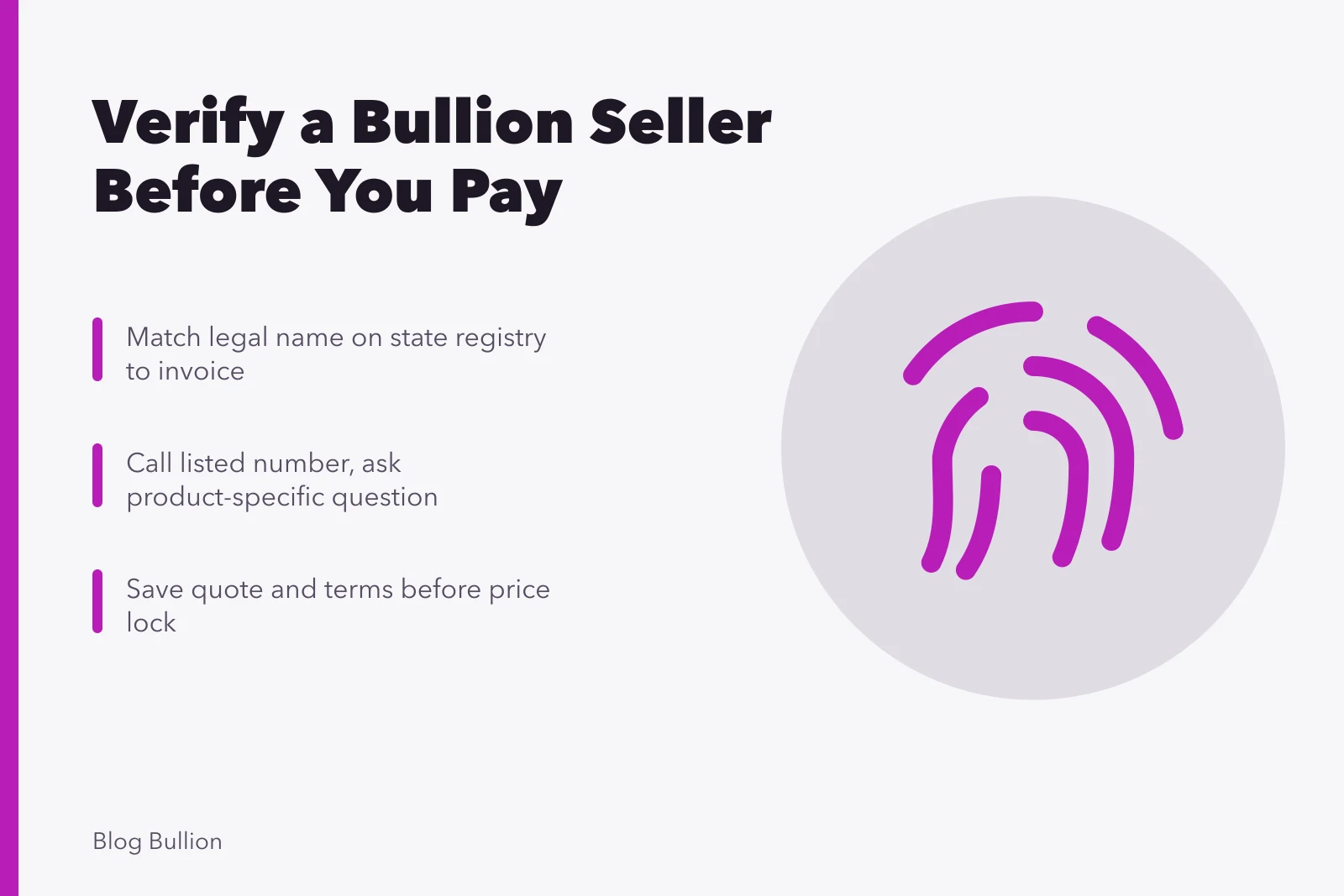
- Match the legal name on the invoice to the state business registry, not to the website footer.
- Get the full quote in writing before you payunit price, premium, shipping, insurance, buyback.
- Never trust changed wire or bank details sent by email. Call a number you already had.
- Photograph the sealed parcel on a scale before you cut anything open.
- Keep one dated folder per order through every dispute, tax and insurance window.
This is for an unfamiliar dealer or a marketplace seller. It does not certify a business or promise delivery. It builds a decision record, so inconsistencies show up early instead of after the wire clears.
Step 1: write down the claimed identity
Identity details to record
- Legal name
- Assumed name
- Entity type
- State of formation
- Street address
- Phone and domain
- Every invoice name
A seal, a footer, or a domain that looks close does not prove ownership of anything.
Search the business registry yourself, through the secretary of state or equivalent office for the state named on the seller's own paperwork. Compare status, formation date, registered address, and exact entity spelling against the invoice. No single national lookup covers this, so the state on the paperwork is the one to pull.
Step 2: test the contact channels
Call a publicly listed number and ask something only a real desk would answer. Name a specific product and ask for its fine weight and current premium.
Map four contact points
Return address
- Match?
- Yes/No
- If differs
- Ask in writing
Shipping origin
- Match?
- Yes/No
- If differs
- Ask in writing
Payment recipient
- Match?
- Yes/No
- If differs
- Ask in writing
Legal entity
- Match?
- Yes/No
- If differs
- Ask in writing
Send an email and check whether the reply comes from the business domain. Then map four things side by side: return address, shipping origin, payment recipient, and legal entity. When they differ, ask for the reason in writing.
Step 3: read reputation, do not count stars
Search the legal and trade names with complaint, lawsuit, refund, delivery, and counterfeit. Read the detailed recent reports, not the totals.
Sort what you find. A buyer angry about a falling spot price is not the same as a buyer who paid and received nothing, or received a substituted bar.
Step 4: request a complete quote
Ask for these details:
Complete quote details
- Product, quantity, fine content
- Year policy, packaging, condition
- Unit price and price-lock rule
- Every charge
- Payment deadline and ship-by promise
- Delivery method and insurance
- Signature requirement and return rule
- Buyback terms
Then ask one more question: does the seller hold the metal now, or expect to source it after you pay? A sourced-to-order bar is a delivery timeline, not inventory.
Step 5: save a prepayment packet
Make a folder named with the date, the seller, and the order number.
Here is the lead-in and list: Save these items:
Prepayment packet contents
- Listing and product photographs
- Terms and return policy
- Quote and invoice
- Registry search results
- Messages and call notes
- Payment instructions with confirmation
Date every file name. One folder beats forty screenshots.
Step 6: confirm the payment destination
Match the recipient name on the payment screen to the name on the invoice. The Postal Inspection Service's financial fraud page puts it plainly: never send money to a mailer, caller, or emailer unless you started the contact.
If bank or wire instructions change mid-order, stop. Call a number you obtained before the change, never one supplied inside the message that changed them. Save the bank confirmation, but keep account credentials out of the general order folder.
Step 7: log fulfillment
Fulfillment events to log
- Promised ship dateseller promise
- Carrier acceptance scancarrier has parcel
- Each tracking eventmovement record
- Delivery signatureproof of receipt
- Any exceptiondelay or damage
A label-created event does not prove the carrier has the parcel. If nothing moves, ask the seller for the carrier acceptance record.
Step 8: document receipt
Photograph the sealed parcel on a scale, then every external surface. Capture the label, seals, dents, cuts, retaping and moisture before opening.
Open without destroying identifying labels. Count the pieces, compare fineness and weight to the invoice, photograph packaging and serial numbers, and record any test separately from what you observed by eye.
Step 9: close or escalate the file
Write a closing note: did the order match, and if not, what exactly differed. List the variance, the remedy you requested, the dates you gave notice, the response, and any outside deadline.
Preserve originals. Send copies.
When a card dispute escalates, write rather than call. The FTC publishes a sample letter for disputing credit and debit card charges that names what the letter needs: account number, the amount and date of the charge, and a short statement of the error.
A line like "the items were never delivered" is enough. Send it to the issuer's billing inquiries division, and contact the issuer first, because a missed timing window can cost you the right to dispute at all.
A worked example: the substituted bar
An order specifies one 100 oz silver bar from a named refiner. The parcel arrives on time and the invoice matches. Inside is a 100 oz bar from a different refiner, same fineness, no serial on the invoice to compare.
The variance is substitution, not shortfall. The file already holds the listing photograph, the invoice, the pre-open parcel photos, and the unboxing photos. The closing note states the exact variance and asks for either the specified bar or a refund of the price difference.
That note, with its dates, is what a card issuer or a state consumer office reads first.
Common questions
Does an active state registration prove good conduct?
No. It matches a legal identity to a business. It says nothing about inventory, solvency, honest advertising, or whether the seller ships.
Is a tracking number proof of shipment?
Not by itself. Look for a carrier acceptance event followed by later scans. A label created at a desk means the seller printed paperwork, nothing more.
Should I email identification documents to a seller?
Only when a rule requires it, through a verified secure channel, with a stated purpose and a stated retention period. Ask what they keep and for how long before you send.
How long should order evidence be kept?
Keep it through every return window, payment-dispute deadline, tax period, insurance claim period, and warranty that may apply. Storage is cheap; a lost photograph is not.