Rules
Do Bullion Dealers Report Cash Purchases to the IRS? Form 8300 Rules
Form 8300 bullion purchases: dealers must report cash sales over $10,000 to the IRS. Here are the thresholds, records, and penalties buyers should know.
What to take away
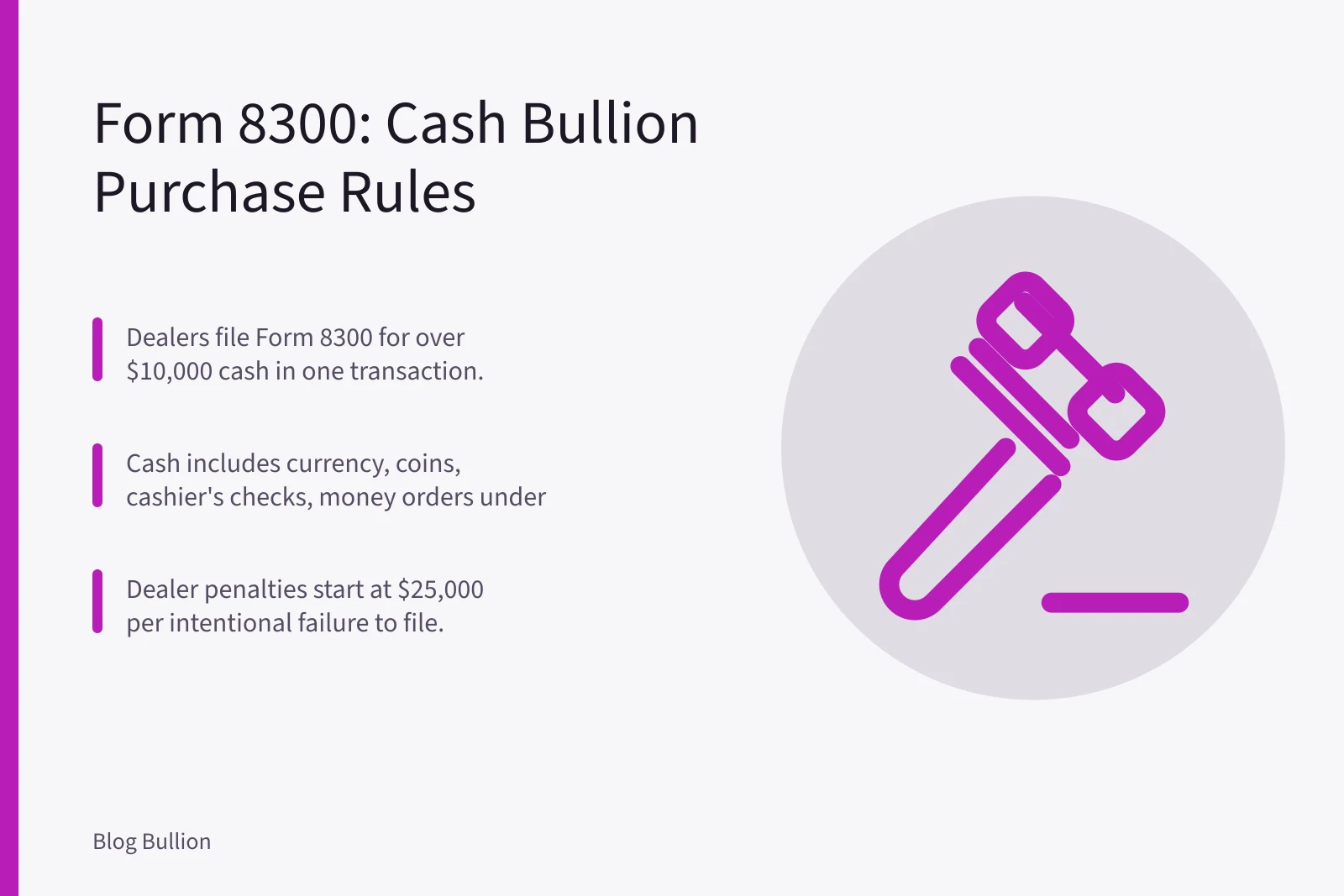
- A bullion dealer that receives more than $10,000 in cash from one buyer in one transaction, or in related transactions within 24 hours, must file Form 8300 with the IRS.
- The filing is the dealer's duty, not the buyer's, but the buyer's name, address, and taxpayer identification number go on the form.
- Cash means currency and coins, plus cashier's checks, bank drafts, traveler's checks, and money orders with a face amount of $10,000 or less.
- Penalties for a dealer who knowingly skips a required filing can reach $100,000 or more for a pattern of violations, and the IRS can also pursue criminal charges.
- Structuring a purchase to stay under $10,000 is itself a federal offense, even if the underlying metal purchase is legal.
Who has to file Form 8300
A bullion dealer is a trade or business that receives cash in the course of that trade. Under Internal Revenue Code section 6050I, that business must file Form 8300 when it receives more than $10,000 in cash in one transaction or in two or more related transactions. The IRS explains the mechanics in Publication 1544.
The rule is not limited to coin shops. A pawnbroker, a jewelry store, a refinery counter, or an online dealer taking cash at a showroom all fall under the same obligation. The trigger is the payment method and the amount, not the product.
What counts as cash
The definition is wider than most buyers expect. Currency and coins count. So do cashier's checks, bank drafts, traveler's checks, and money orders, but only if each has a face amount of $10,000 or less. A single cashier's check for $12,000 is not treated as cash for this purpose.
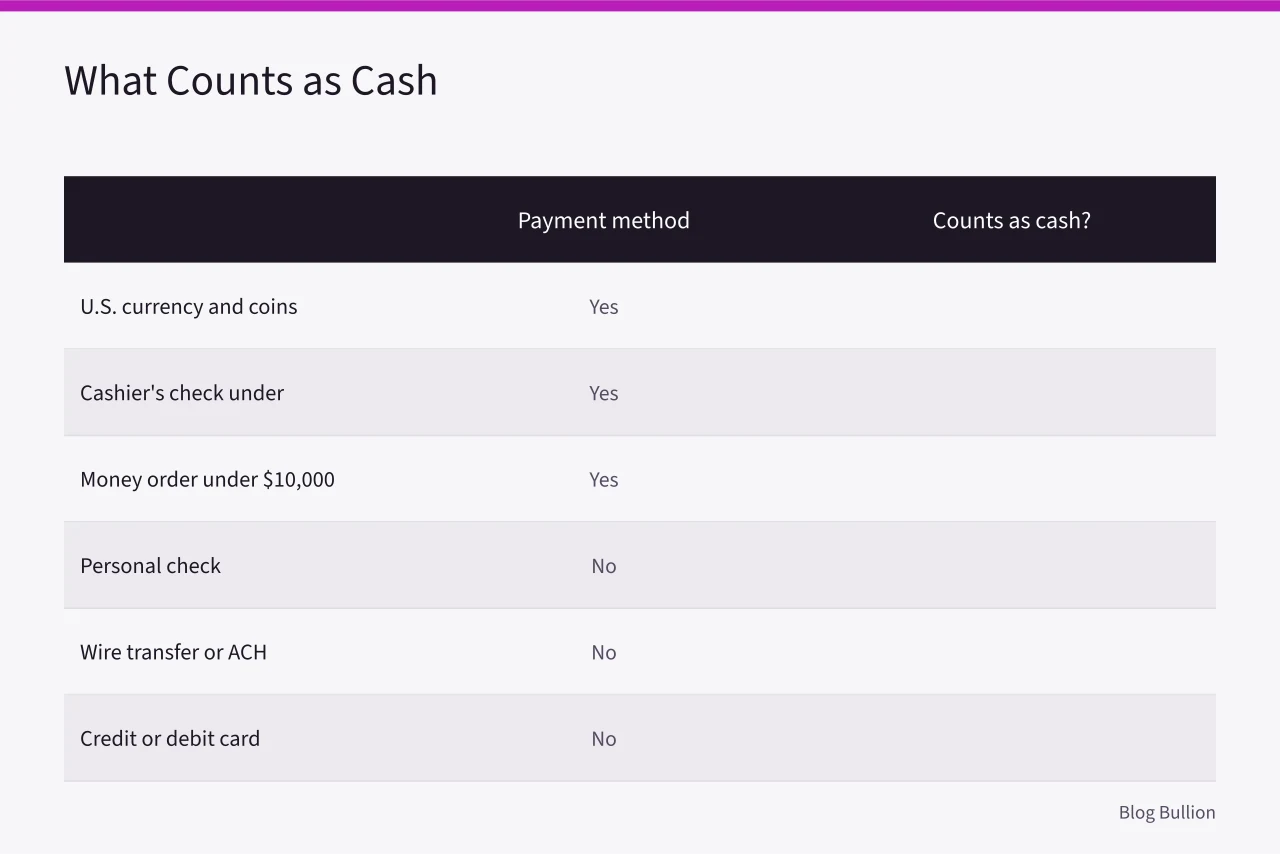
| Payment method | Counts as cash for Form 8300? |
|---|---|
| U.S. currency and coins | Yes |
| Cashier's check under $10,000 | Yes |
| Money order under $10,000 | Yes |
| Personal check | No |
| Wire transfer or ACH | No |
| Credit or debit card | No |
Related transactions matter. If a buyer splits a $15,000 purchase across two days to dodge the threshold, the dealer must treat those payments as related and file. The IRS instructions for Form 8300 spell out the 24 hour rule and the evidence a dealer can use to connect separate payments.
A dealer who accepts $9,800 in cash today and $9,800 tomorrow from the same buyer has a filing obligation, not a loophole.
Records a dealer must keep
The dealer must keep a copy of each Form 8300 for five years from the date of filing. The record should show the buyer's name, address, and taxpayer identification number, the date and amount of the cash, and a description of the metal sold.
If the buyer refuses to give a taxpayer identification number, the dealer still files. The form has a box for that. A dealer cannot simply decline the sale and move on once cash over the threshold has changed hands.
The buyer should expect to show a driver's license or passport. That is a normal part of a compliant counter sale, and a dealer who waves it off is taking on risk that eventually shows up in an audit.
What happens if you do not comply
For the dealer, the civil penalty for an intentional disregard of the filing requirement starts at $25,000 per failure and can run higher. The IRS can also bring criminal charges under sections 7203 and 7206 for willful failure to file or for filing a false return.
For the buyer, the sharper risk is structuring. Under 31 U.S.C. section 5324, breaking a transaction into pieces to avoid a reporting requirement is a crime, and the government does not need to prove the metal purchase was illegal. A buyer who pays $9,900 in cash three days running to stay under the line has created the offense.
That is a different statute from the capital gains rules that apply when the metal is later sold. Those are covered in How IRS Form 1099-B and 8300 reporting works for bullion sellers.
Where the rules differ by place
Form 8300 is federal and applies in every state. State law adds its own layer. Some states require dealers to hold a precious metals license and to keep transaction records that mirror the federal form, and a few require reports to local law enforcement for large cash sales.
Sales tax treatment also varies. Texas exempts certain bullion purchases, while California and New York apply different rules depending on the amount and the form of the metal. The state-by-state picture is set out in How US sales tax on bullion works across Texas, California, New York and Florida.
A buyer moving a large cash purchase across state lines should also check the dealer's licensing status. That step is covered in How to evaluate bullion dealers in New York City, licenses, complaints and COMEX ties.
Example
A buyer walks into a coin shop with $16,000 in hundred dollar bills and buys four one ounce gold coins. The dealer counts the cash, asks for a driver's license, and completes Form 8300 at the counter. The buyer signs nothing. The dealer mails the form to the IRS within 15 days.
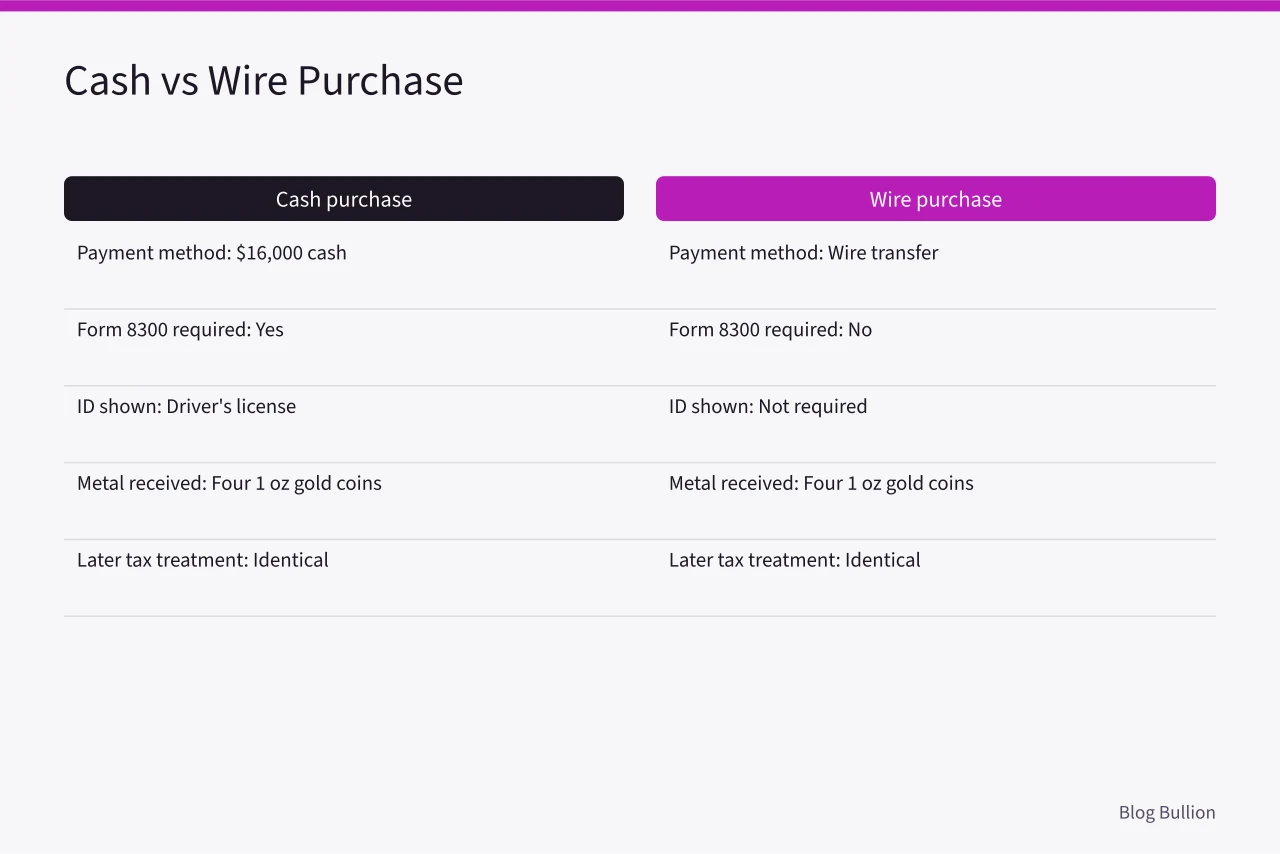
If the same buyer had paid by wire, no Form 8300 would be required. The metal would be identical, and the tax treatment on a later sale would be identical. Only the payment method changed the paperwork.
Common questions
Does the dealer tell the IRS my name? Yes. Form 8300 includes the buyer's name, address, and taxpayer identification number, and the dealer files it with the IRS. The dealer must also give the buyer a written statement by January 31 of the following year.
Is a cash purchase over $10,000 illegal? No. Paying cash for bullion is legal. The dealer simply has to report it. What is illegal is splitting payments to avoid the report.
Do I owe tax just because Form 8300 was filed? No. Form 8300 is an information return about a cash payment, not a tax bill. Any tax owed comes from a later sale, and that gain is reported on Schedule D.
What if I buy from a private seller? A private individual selling personal metal is not a trade or business, so Form 8300 generally does not apply. A dealer acting as an intermediary still has to file, and the buyer should keep a receipt either way.