Rules
IRS Form 8949 for Physical Gold Sales: How to Report Capital Gains
IRS Form 8949 gold sales must be reported sale by sale, with basis and proceeds on Schedule D. Here is who files, what to keep, and the penalty for getting it wrong.
What to take away
- The IRS has jurisdiction over every sale of physical gold you own, whether the dealer reports it or not.
- Form 8949 lists each sale separately; Schedule D totals them and carries the result to Form 1040.
- Collectibles held over a year are taxed at a maximum rate of 28 percent, higher than the 20 percent top rate on stocks.
- Your cost basis is what you paid plus dealer premiums, shipping and insured freight, not the spot price on the day you bought.
- Missing or wrong basis does not erase the tax; the IRS can treat the entire proceeds as gain and add penalties.
A sale of one American Gold Eagle triggers the same paperwork as a sale of fifty. The obligation attaches to the disposition, not to the size of the order, and it applies to coins, bars and rounds alike.
Who has jurisdiction and who must file
The Internal Revenue Service administers federal income tax on gold sales under the Internal Revenue Code. Every U.S. person who sells a capital asset at a gain files Schedule D instructions from the IRS and attaches Form 8949. State revenue departments may also tax the gain, though most states follow federal adjusted gross income as the starting point.
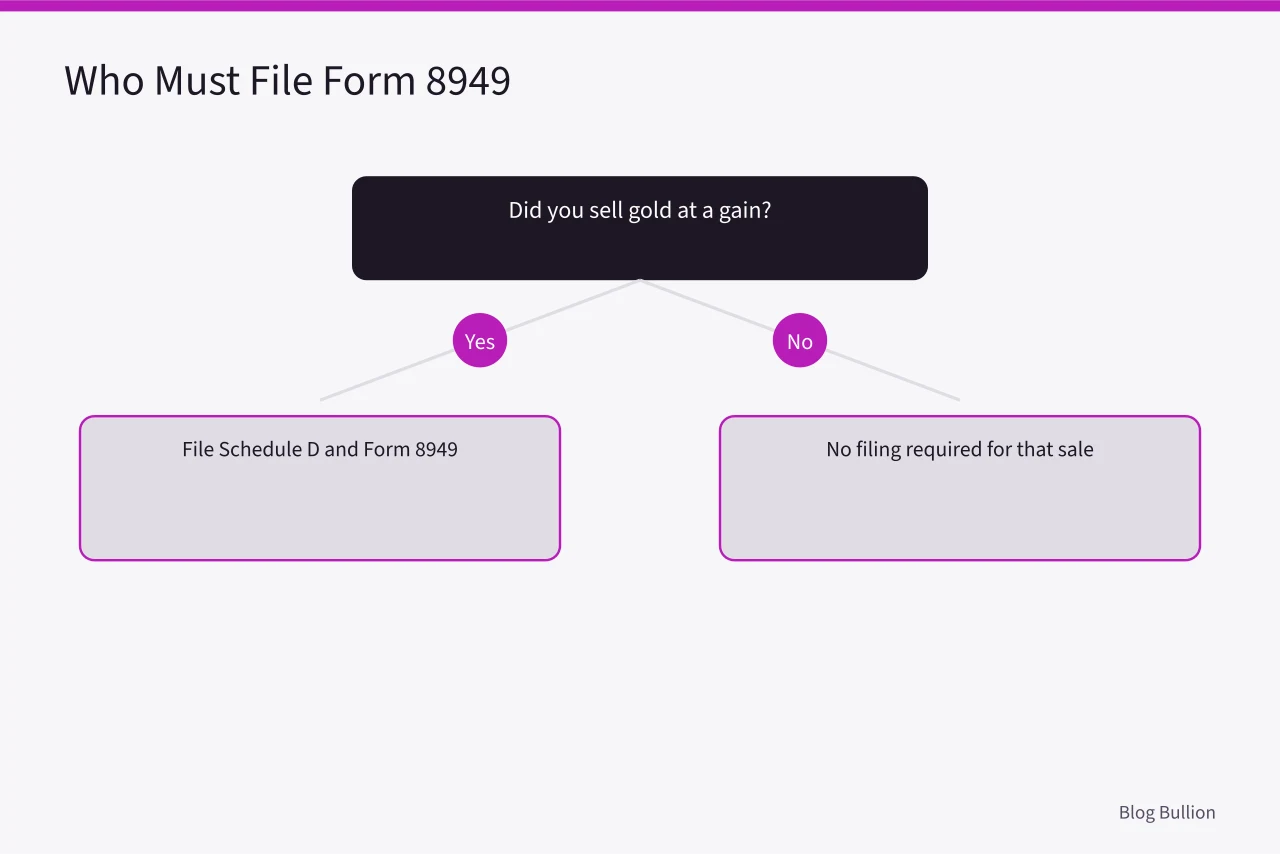
A dealer is not the taxpayer. A coin shop in Dallas or a bullion desk in New York files its own return and may send you a Form 1099-B. That form helps you, but the duty to report sits with the seller. The instructions for Form 8949 set out the boxes and codes you must use.
What a compliant Form 8949 contains
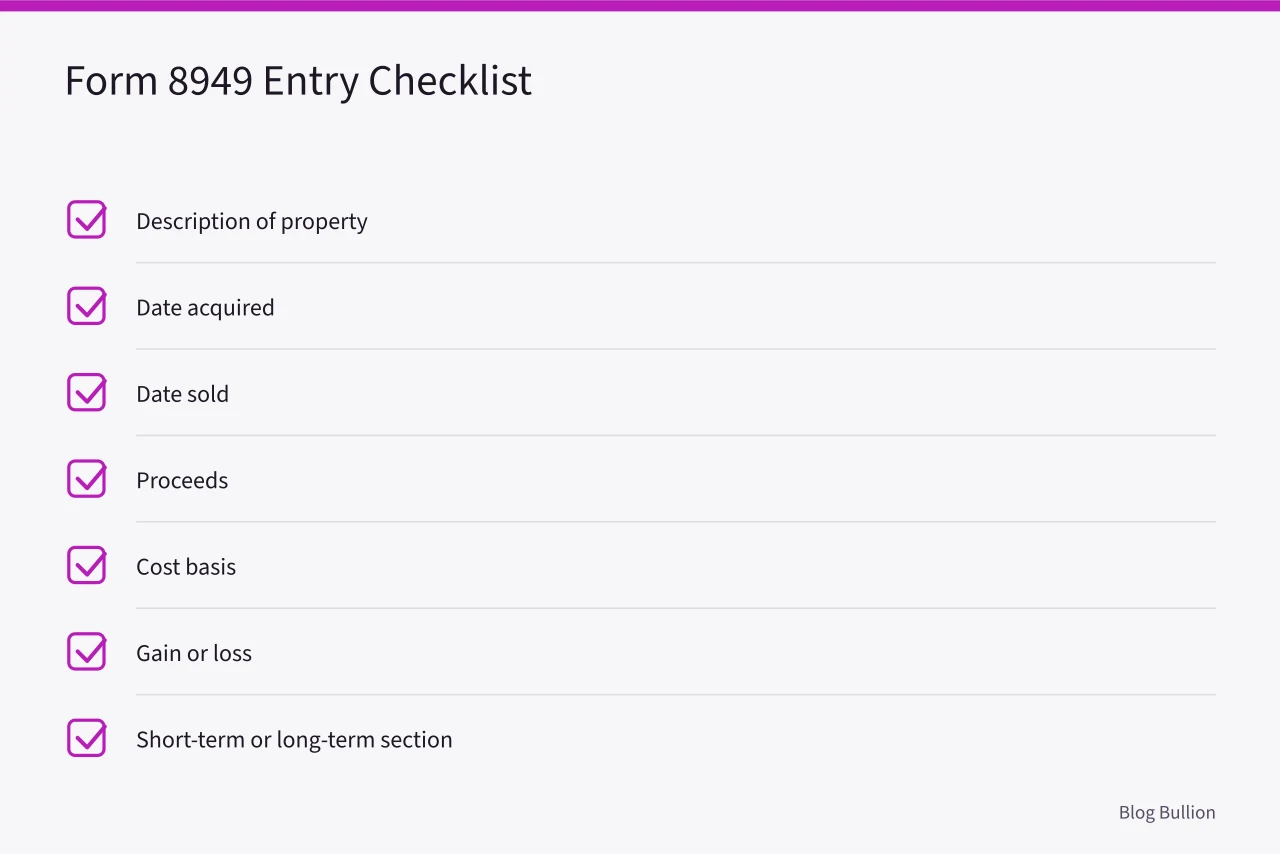
Each sale gets its own line. A compliant entry carries the description of the property, the date you acquired it, the date you sold it, the proceeds, your cost basis, and the resulting gain or loss. The short-term and long-term sections are separate, because the holding period decides the rate.
The description should identify the item specifically: "1 oz American Gold Eagle" or "10 oz silver bar, serial 12345." Vague descriptions invite questions. If a broker reported the sale to the IRS, you check box A or D; if not, box B or E. The instructions explain the codes for wash sales and other adjustments.
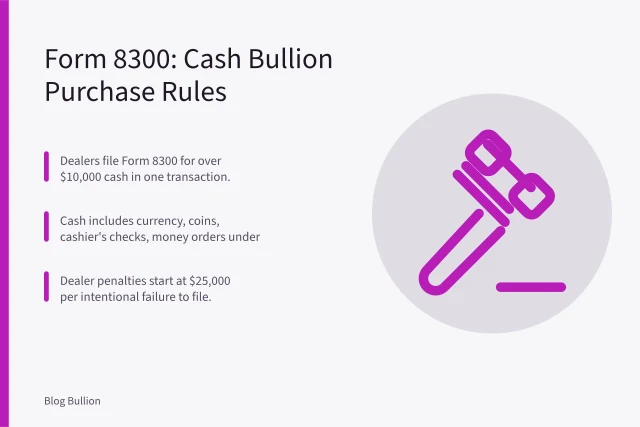
A second form matters for cash. A dealer that receives more than $10,000 in cash in one transaction, or in related transactions, must file Form 8300. The IRS instructions for Form 8300 define cash and list the reportable events. This is the dealer's duty, not yours, but it is why a large cash sale draws attention.
Records to keep, and for how long
- Dealer invoice showing date, quantity, item and total paid
- Shipping and insurance receipts added to basis
- Bank or card statement proving the payment
- Sale confirmation showing gross proceeds and any commission
- A running spreadsheet with acquisition date and cost per ounce
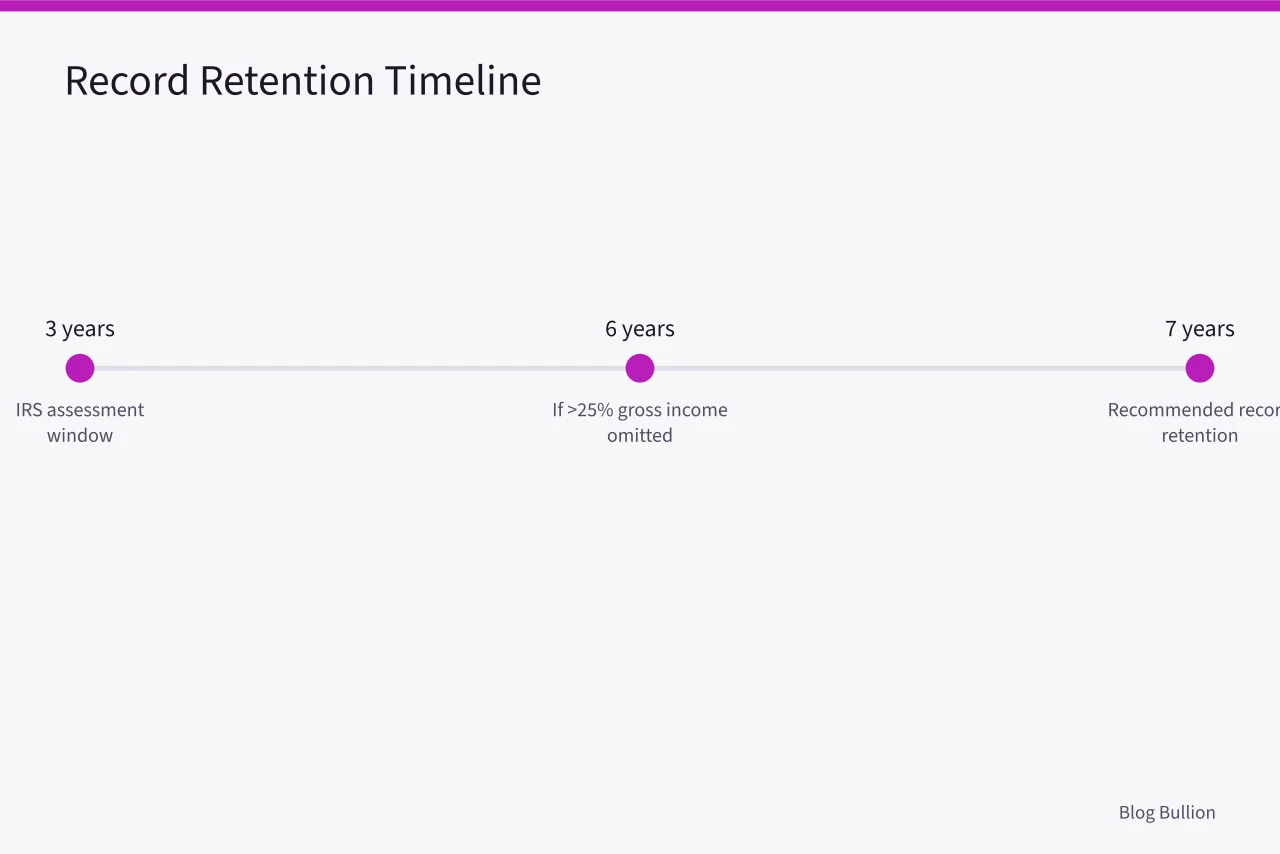
The IRS generally has three years from the filing date to assess additional tax, and six years if you omit more than 25 percent of gross income. Keep records at least seven years. If you inherit gold, keep the estate's valuation date records, because your basis steps up to fair market value at death.
What happens if you do not file
The concrete consequence is money. A missing Form 8949 means the gain is unreported, and the IRS can assess the tax plus an accuracy-related penalty of 20 percent of the underpayment under section 6662. Interest runs from the original due date.
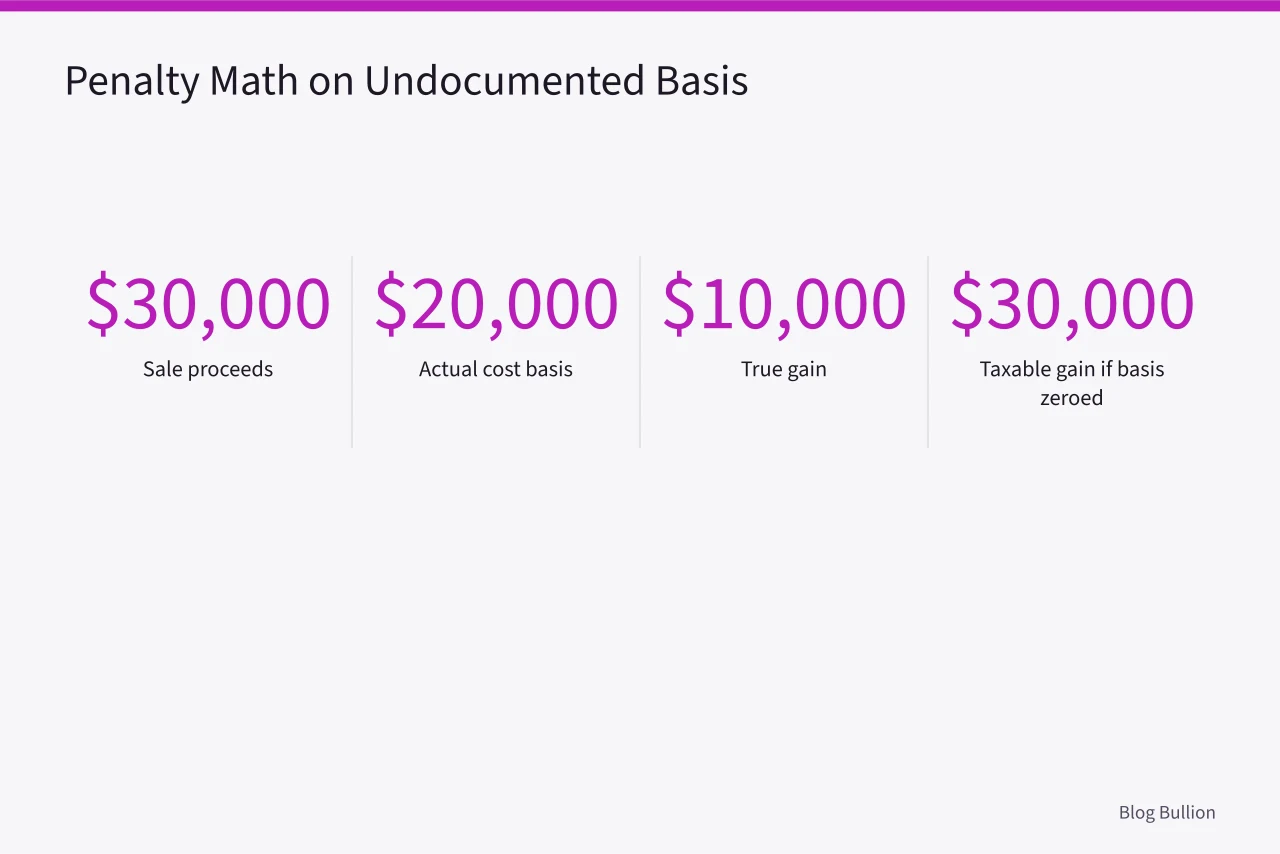
Worse, if you cannot document basis, the examiner may assign a basis of zero. On a $30,000 sale of coins bought for $20,000, that turns a $10,000 gain into $30,000 of taxable gain. At the 28 percent collectibles rate the difference is roughly $5,600 in extra tax before penalties, an illustrative figure based on those inputs.
Willful failure to report can escalate to criminal exposure. That is rare, but it is the stated ceiling, and it is why dealers ask for identification on larger sales.
Where the rules differ by place
Federal law is uniform, but state treatment of the gain is not. States with no income tax, including Texas, Florida and Nevada, impose nothing on the sale. California and New York tax capital gains as ordinary income, so a gold sale can push you into a higher bracket.
Sales tax is a separate question that trips up sellers. Most states exempt investment-grade bullion, but the definitions vary, and some states require a minimum purchase amount. Our guide to how US sales tax on bullion works covers the four largest markets.
One more federal form can apply. A dealer must report certain bullion sales to the IRS on Form 1099-B when the quantity crosses a threshold, such as 25 ounces of gold bars or 1,000 ounces of silver. Our explainer on IRS Form 1099-B reporting for sellers walks through those triggers.
Example: a single sale, start to finish
Suppose you bought ten 1 oz Gold Eagles in March 2019 for $13,500 including premium and shipping. You sell them in September 2025 for $26,000, net of the dealer's commission.
- Confirm the holding period exceeds one year, so the sale is long term.
- Enter the description, acquisition date and sale date on Form 8949, Part II.
- Report proceeds of $26,000 and basis of $13,500.
- Compute the gain: $12,500.
- Carry the total to Schedule D, then to Form 1040.
The gain is taxed at the collectibles rate, capped at 28 percent. If your ordinary bracket is lower, you pay the lower rate. That is the whole filing, and the only hard part is the basis figure.
Common questions
Does a dealer always send me a Form 1099-B? No. Reporting depends on the metal, the form and the quantity. Coins such as Gold Eagles are generally not reported, while bars above the threshold are. You still report the sale.
What if I lost my purchase receipts? Reconstruct the basis from bank statements, card records or dealer reprints. If nothing survives, the IRS may allow a reasonable estimate, but an undocumented claim is weak. Our guide on calculating an all-in bullion price shows the cost components to rebuild.
Do I owe tax if I sold at a loss? Yes, you report it, and the loss can offset other capital gains. Collectible losses are deductible against capital gains, though the rules on using them against ordinary income are tighter.
Does buying through a dealer in another state change anything? Not for federal tax. The gain is the same. Cross-border purchases bring customs and duty questions, which our piece on US and Canada bullion purchases addresses.