Rules
How to Buy Gold in a Self-Directed IRA Without Prohibited Transactions
Self-directed IRA gold rules require an IRS-approved custodian, a qualified depository, and avoiding disqualified persons. Here is what compliance looks like.
What to take away
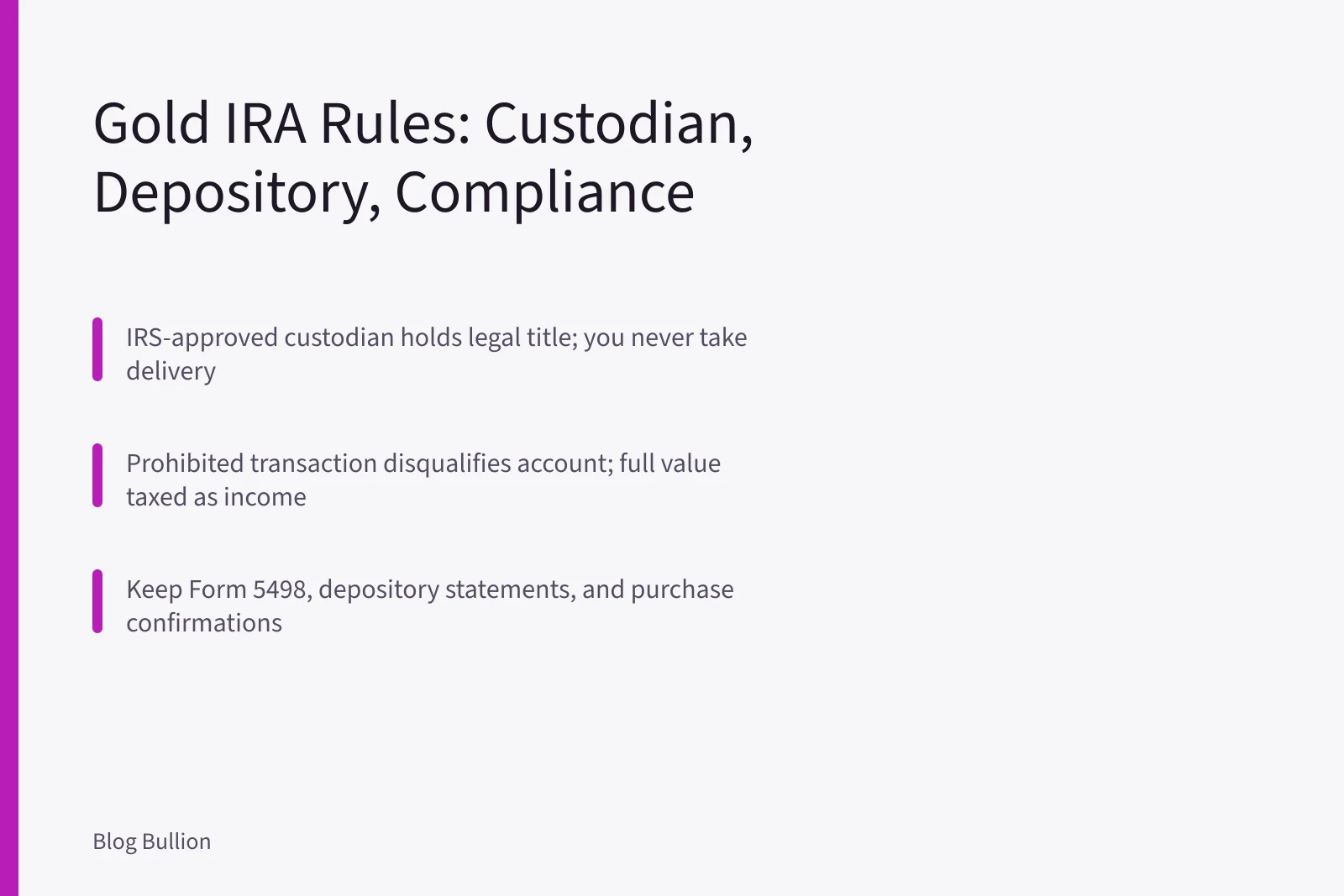
- Only an IRS-approved custodian or trustee can hold the account, and the gold itself must sit in an approved depository or with an approved trustee. You never take delivery.
- The IRS defines prohibited transactions under Internal Revenue Code section 4975, and the account owner is a disqualified person. Buying gold from yourself, or storing it in your own home, breaks the rules.
- IRS Publication 590-A sets out contribution and investment rules for individual retirement arrangements, including the prohibition on certain investments.
- The concrete consequence of a prohibited transaction is disqualification: the account stops being an IRA as of the first day of that tax year, and the full fair market value becomes taxable income.
- Keep purchase confirmations, depository statements, custodian fee records, and Form 5498 for as long as the account exists plus the retention period after it closes.
Who has jurisdiction over a gold IRA
The Internal Revenue Service writes the rules. The custodian you choose must be a bank, trust company, or IRS-approved non-bank custodian, and it holds legal title to the metal on the account's behalf.
A self-directed IRA is not a different kind of account under the tax code. It is a standard IRA whose custodian permits alternative assets. That distinction matters because many investors assume the label carries extra permissions. It does not. The same prohibited transaction rules in IRS Publication 590-A apply to every IRA.
The gold itself must meet a fineness standard. IRS-approved coins include the American Eagle and American Buffalo, and approved bars must be at least 99.5 percent pure for gold. Your custodian is responsible for confirming this before settlement.
What a compliant disclosure contains
A custodian's account agreement has to tell you several things in writing. Read for these items before you sign.
- The name of the depository where metal will be stored, and whether it is segregated or commingled.
- The fee schedule: setup, annual administration, storage, and per-transaction charges.
- The procedure for directing a purchase, including how spot price is captured.
- The procedure for a distribution, including whether in-kind distribution of metal is permitted.
- A statement of the disqualified persons list and the transactions that are barred.
If an agreement is vague about storage location or omits the disqualified persons language, that is a reason to keep looking. The IRS page on prohibited transactions lists the categories of parties you cannot deal with.
A custodian that will not name the depository in writing is a custodian you should not use.
Records to keep
- Purchase confirmations showing date, quantity, fineness, and price paid
- Depository statements, at least annually
- Custodian fee invoices and payment records
- Form 5498, which the custodian files and sends to you each year
- Any distribution paperwork, including Form 1099-R
The retention rule is simple. Keep records for the life of the account, and for the period the IRS can assess tax afterward. For most situations that is at least three years past the filing date of the return reporting the transaction, per IRS Publication 590-B.
What happens if you do not comply
A prohibited transaction disqualifies the entire account. Under the statute, the account is treated as distributing all its assets on the first day of the tax year in which the transaction occurred.
That means the full fair market value lands on your return as ordinary income, not capital gain. If you are under 59 and a half, the 10 percent early distribution penalty generally applies on top. The metal is no longer retirement money.
Common triggers are easy to miss. Storing coins in your own safe, paying a storage invoice from your personal checking account, or selling metal to a family member all qualify. So does borrowing against the metal. A custodian handles these mechanics for a reason.
If you want a plain look at what a dealer actually charges on top of spot, the bullion pricing guide breaks down premium, spread, and fees line by line.
Where the rules differ by place
Federal rules on fineness and prohibited transactions do not change by state. What changes is tax treatment on the metal itself and, in some cases, the depository you can use.
Texas operates a state depository that some custodians use for storage. The Texas depository and vault rules explain how that arrangement works and who supervises it. Other states have no equivalent facility, so metal sits in a private depository approved by the custodian.
State sales tax is a separate question and does not apply to purchases made inside an IRA, because the account is the buyer. It does apply when you take a distribution in kind and later sell. Several states exempt bullion entirely; the state-by-state sales tax breakdown covers the common cases.
One more point on reporting. When you eventually sell metal outside an IRA, a dealer may file Form 1099-B or Form 8300 depending on the transaction. The 1099-B and 8300 reporting guide lays out which sales trigger which form.
Common questions
Can I store IRA gold at home? No. The tax code requires an approved trustee or custodian to hold the asset, and home storage is treated as a distribution. The account loses its tax status.
Does a self-directed IRA let me buy any gold coin? No. The metal must meet IRS fineness standards, which generally means 99.5 percent purity for gold bars and specific approved coins. Your custodian confirms eligibility before purchase.
What counts as a disqualified person? You, your spouse, your lineal descendants and ancestors, and certain entities you control. Buying from or selling to any of them is a prohibited transaction.
Is a custodian required, or can I act as my own trustee? Some individuals serve as trustee of a self-directed IRA in limited circumstances, but the practical route for most investors is an approved custodian that handles depository arrangements and reporting.