Guides
Guide to Bullion Insurance: Scheduled Personal Property vs Homeowners Riders
Bullion insurance homeowners vs scheduled coverage: why standard policies cap or exclude coins, and how endorsements, appraisals and floater limits really work.
What to take away
- A standard U.S. homeowners policy (ISO HO-3 form) treats bullion as money or bullion, and most carriers exclude it or cap it near $200 to $500.
- A scheduled personal property endorsement, sometimes called a personal articles floater, insures listed items at agreed value with no deductible.
- A blanket rider covers a category up to a stated limit without itemizing each coin, but it usually requires an appraisal.
- Neither approach fixes the real gap: you still need a receipt, a photo record, and a safe place to store the metal.
What is being compared
Two insurance products get confused constantly. One is the homeowners policy you already own. The other is a scheduled endorsement bolted onto that policy or written as a stand-alone floater.
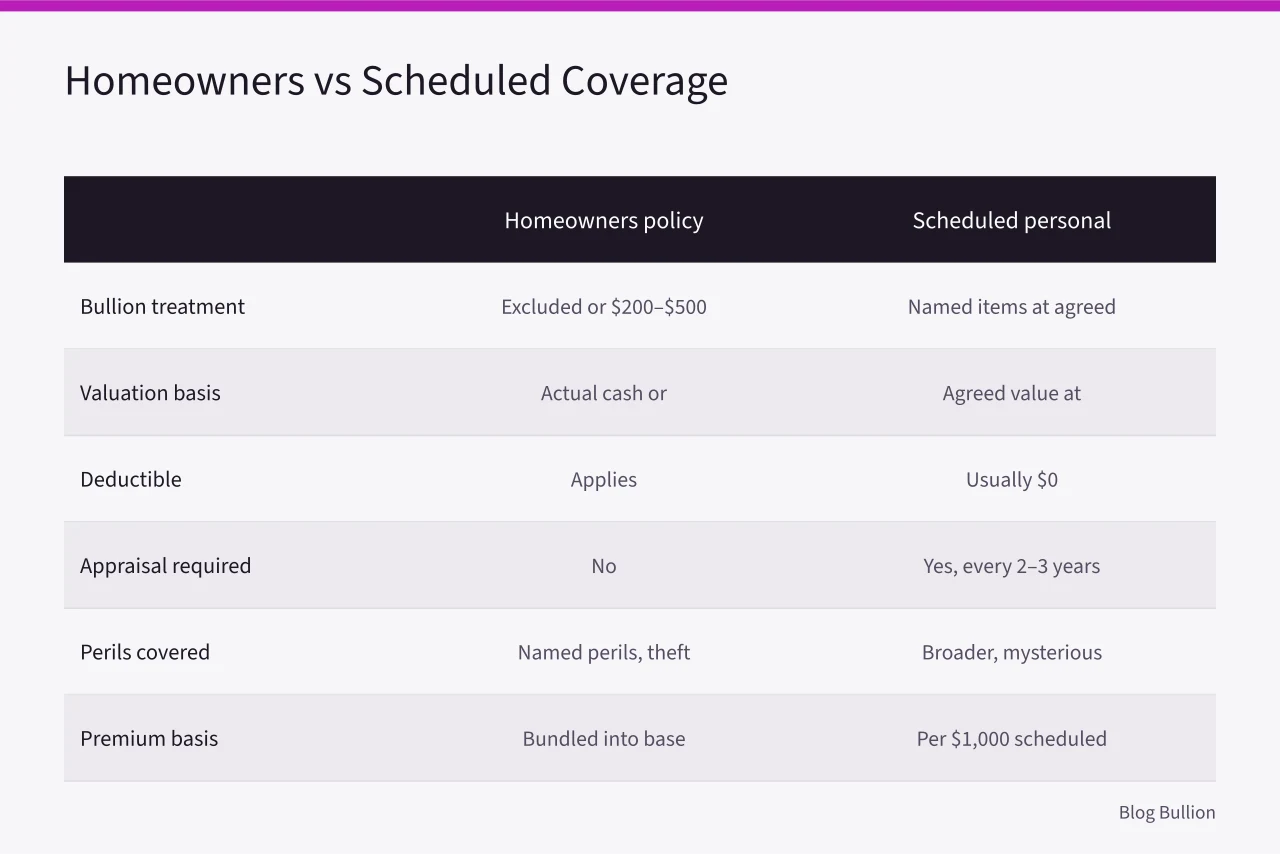
They differ in how they value the metal, what they pay after a loss, and what paperwork they demand up front. The table below sets out the criteria that decide which one fits your holdings.
| Criterion | Homeowners policy (base) | Scheduled personal property |
|---|---|---|
| Typical bullion treatment | Excluded as money, or sub-limit near $200 to $500 | Named items covered at agreed value |
| Valuation basis | Actual cash value or replacement cost, subject to limit | Agreed value set at appraisal |
| Deductible | Applies | Usually $0 |
| Appraisal required | No | Yes, often every 2 to 3 years |
| Perils covered | Named perils, theft included with limits | Broader, including mysterious disappearance |
| Premium basis | Bundled into the base policy | Per $1,000 of scheduled value |
Ranges above are illustrative of common U.S. carrier practice, not quotes. Your declarations page and the actual endorsement language control.
Reading the exclusion that matters
The base policy is the problem. Standard forms list money and bullion alongside securities and deeds, and cap the whole category at a few hundred dollars. A tube of American Gold Eagles can blow past that cap in one purchase.
Some carriers add an optional endorsement that raises the sub-limit to $1,000 or $2,500. That still leaves a serious stack uninsured. Ask for the declarations page and the endorsement form number, then read the loss settlement clause. Agreed value pays the number on the schedule. Replacement cost pays what it takes to buy the same coin today, which can be higher or lower.
A homeowners policy is not bullion coverage. It is a small courtesy limit attached to a policy built for furniture and drywall.
Option by option
Scheduled personal property. You list each item, submit an appraisal, and the carrier insures the schedule at agreed value. This is the cleanest fit for graded coins, key dates, and large bars. It costs more per dollar of coverage and creates paperwork every time you buy or sell. Add a coin and you must endorse the policy.
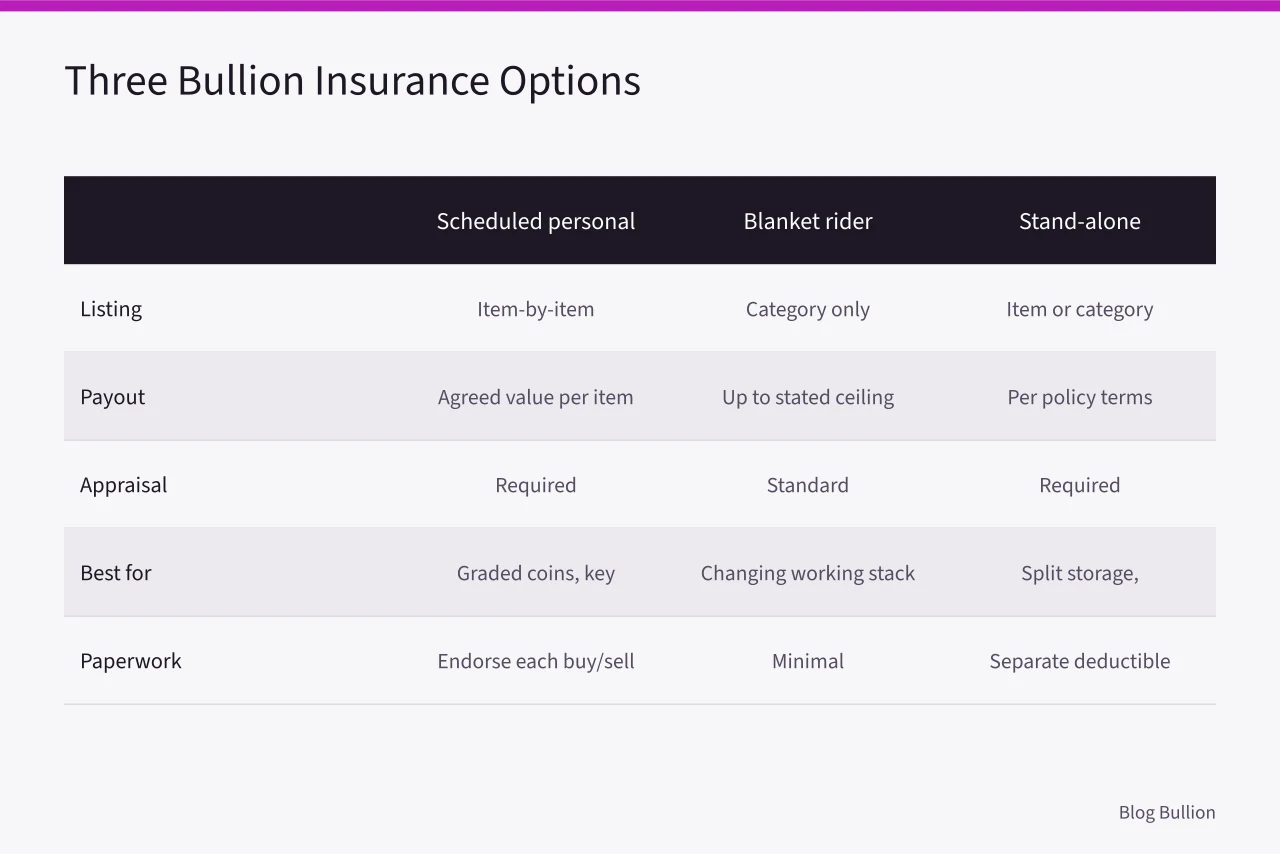
Blanket rider. The carrier covers a category, say all gold coins, up to a stated ceiling. No item-by-item listing, but the ceiling is the whole payout. If your holdings grow past it, you are underinsured and may not notice. Appraisals are still standard.
Stand-alone floater. Written outside the homeowners policy, often through a specialty carrier. Useful when the base insurer will not write bullion at all, or when you store metal away from home. Expect a separate deductible and a separate renewal date.
Where each one wins
Schedule when you own a small number of high-value pieces and want agreed value with no deductible. A collector with five graded $20 Saint-Gaudens doubles fits here.
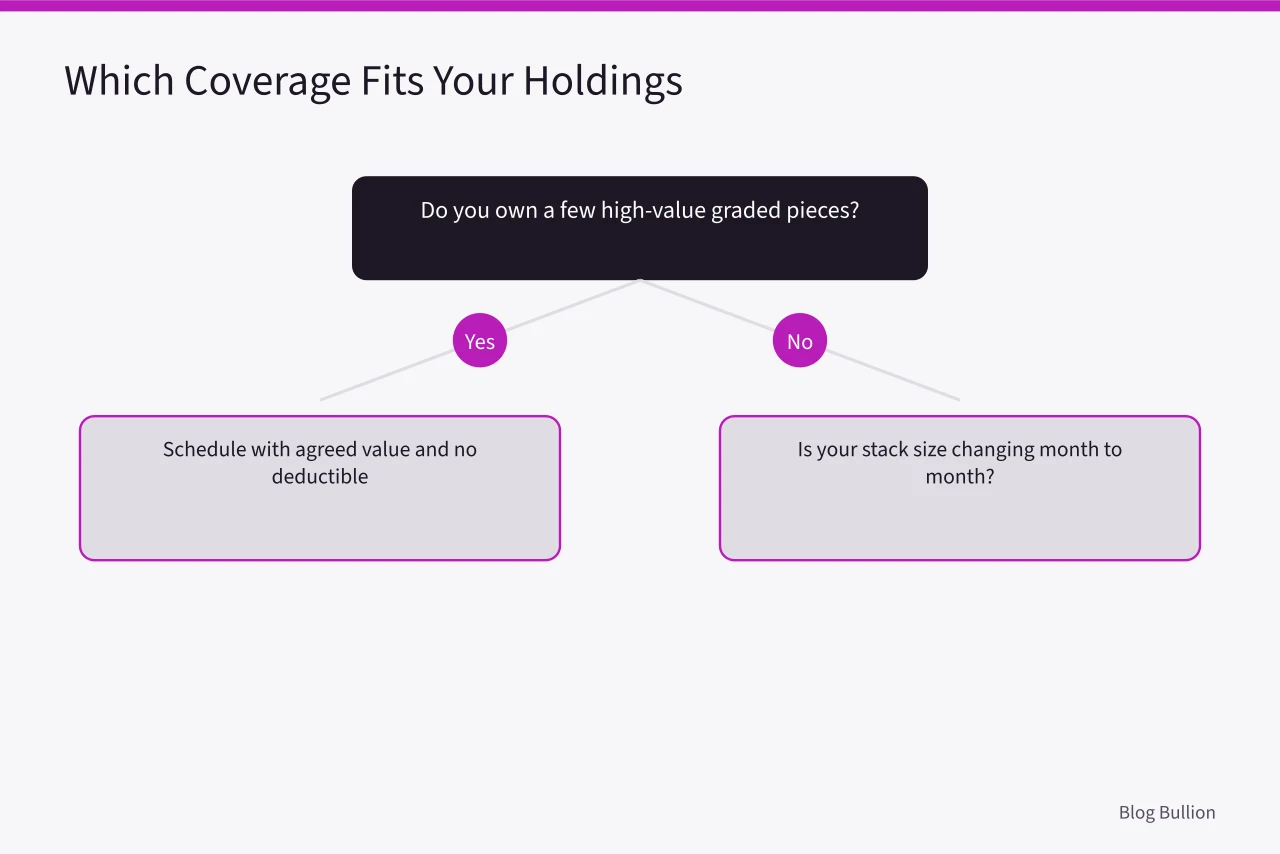
A blanket rider wins for a working stack that changes size month to month. You trade precision for simplicity, and you accept a hard ceiling.
A stand-alone floater wins when storage is split between a home safe and a depository. The storage rules in Texas show how a commercial vault changes the risk picture, and insurers price that differently.
Before you bind anything, know your all-in cost basis. The break-even method keeps premium from quietly eating your margin.
What none of them solve
No policy pays on a loss you cannot document. Carriers want purchase receipts, serial numbers where they exist, and dated photographs. A safe deposit box helps, but the box itself is not insured by the bank, as the background on safe deposit boxes makes clear.
No policy covers confiscation, government seizure, or a dealer who never delivers. Those are counterparty risks, not insurable perils. Dealer screening matters more than the endorsement, which is why dealer licensing checks belong in the same conversation.
Finally, none of these products resolve tax treatment. A theft loss and a sale are different events, and the IRS instructions for Form 8949 govern how dispositions get reported.
A practical checklist before you call a carrier
- Photograph every coin, bar, and sealed tube with a dated card in frame.
- Keep purchase invoices in a location separate from the metal.
- Get a written appraisal from a qualified appraiser for anything scheduled.
- Read the declarations page for the money and bullion sub-limit.
- Re-check scheduled values every 2 to 3 years as spot moves.
Common questions
Does homeowners insurance cover gold coins at all? Usually only up to a small sub-limit, often a few hundred dollars, and only for named perils such as theft. Anything beyond that needs an endorsement or a floater.
Is a scheduled personal property endorsement worth the premium? For high-value or graded pieces, yes. Agreed value and a zero deductible remove the argument at claim time. For a small generic stack, the premium may exceed the risk.
Do I need a new appraisal every year? Most carriers ask for one every 2 to 3 years, or after a large move in spot price. Check the endorsement, because the interval is written into the policy.
What happens if I add coins and forget to schedule them? They fall back under the base policy sub-limit. That is the most common way collectors end up underinsured without realizing it.