
Rules
Physical Gold in a Living Trust: How to Title Bullion for Heirs Without Probate
Physical gold living trust titling decides whether heirs get bullion directly or through probate. Here is what trustees must disclose, keep, and file.
What to take away
- A living trust only controls gold that is actually titled to it. Gold left in your name goes through probate in your state.
- Retitling is paperwork with the dealer, depository, or bank, not a new purchase. Expect a trust certificate, a new account agreement, and an updated inventory.
- Trustees owe beneficiaries a duty to account. That means records of what the trust holds, where it sits, and what it earned.
- Skipping the retitling step is the most common failure. The consequence is a probate case that can run months and consume fees before any heir touches a coin.
- State law, not federal law, sets probate rules and most bullion sales tax. Both vary by where you live and where the metal sits.
A living trust is a written agreement that holds property for your benefit while you live and moves it to named beneficiaries when you die. The IRS treats a revocable trust as a grantor trust during your life, so income and gains stay on your personal return. The probate advantage comes from ownership, not from the document itself. If the gold is not titled to the trust, the trust has nothing to pass.
Who has jurisdiction over the gold
Jurisdiction follows the metal. Bullion in a home safe sits in your state of residence. Bullion in a depository sits where the vault sits, which may be another state. A safe deposit box is governed by the bank's agreement and state law on box access after death.
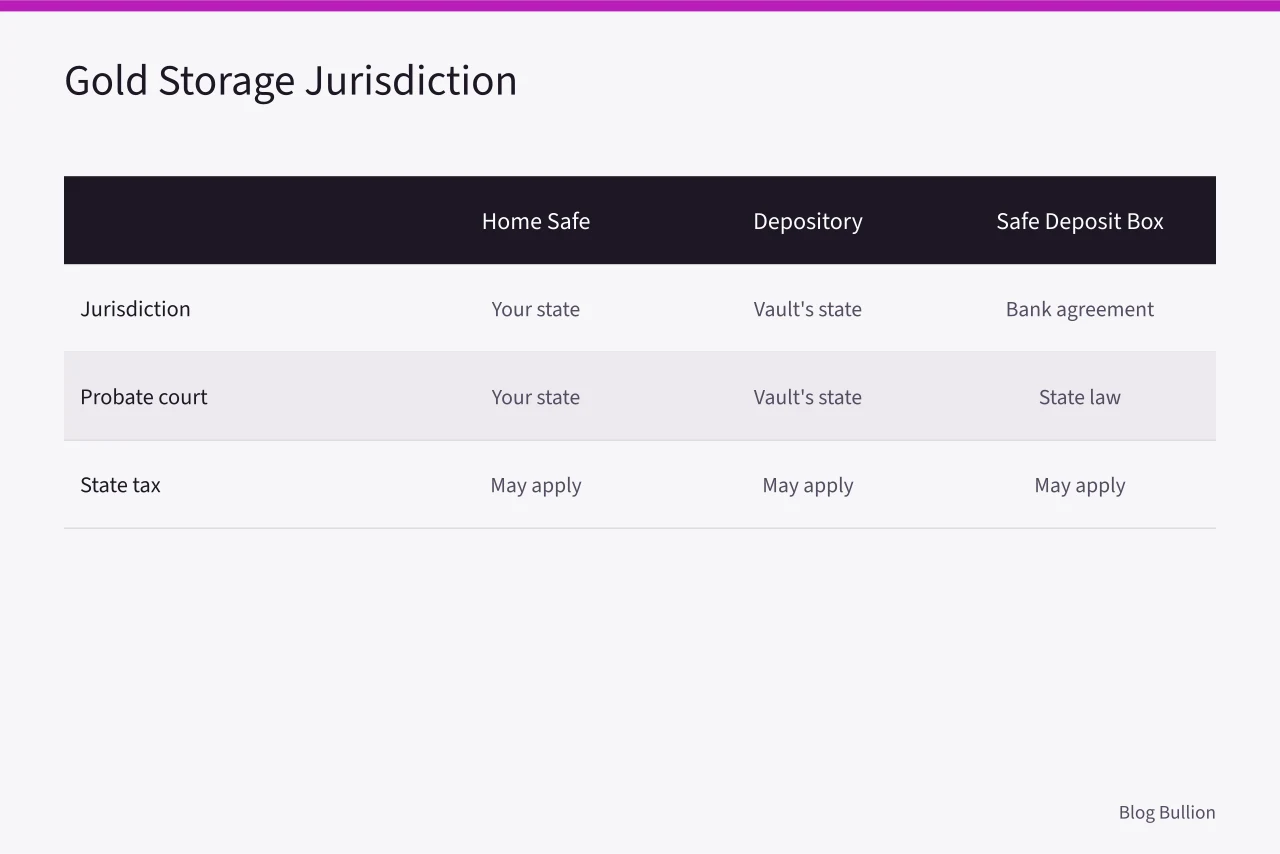
That matters for two reasons. First, probate is a state court process, so the location of the asset decides which court supervises it. Second, a state may tax the sale of bullion, and rules differ. Review the state sales tax picture before you move metal across lines.
Federal rules sit on top. A trust with gold is not exempt from capital gains reporting, and the IRS explains how sales of assets are treated in Publication 544. Trustees should read that alongside any state guidance.
What must be disclosed
A compliant trustee disclosure tells beneficiaries what the trust owns, where it is held, and what it is worth as of a stated date. It should identify the custodian or depository by name, list the specific items or bars, and note any encumbrance such as a loan or storage lien.
Most states require an accounting at least annually and on request, under the Uniform Trust Code or a state variant. The accounting lists receipts, disbursements, and the assets on hand. A gold holding with no purchase date or cost basis is an incomplete record.
The disclosure duty is not satisfied by telling heirs that "there is gold in a vault." It is satisfied by a dated inventory with weights, form, and location.
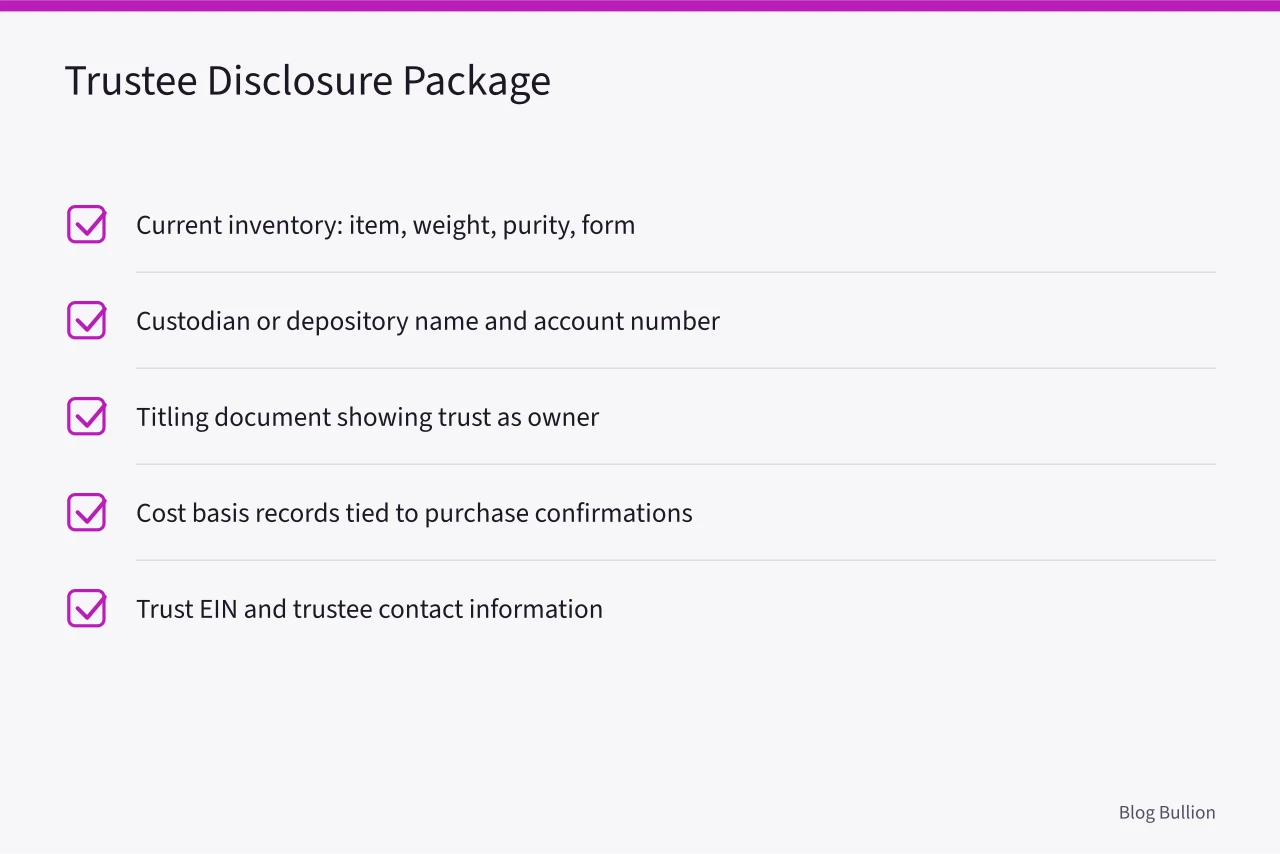
A practical disclosure package contains:
- A current inventory with item, weight, purity, and form
- The custodian or depository name and account number
- The titling document showing the trust as owner
- Cost basis records for every lot, tied to purchase confirmations
- The trust's EIN and the trustee's contact information
Records to keep for an audit trail
Keep purchase confirmations, storage invoices, insurance riders, and any transfer paperwork for the life of the trust plus the state limitations period. Cost basis records matter because heirs receive a stepped-up basis at death, and the estate must be able to prove the date-of-death value.
Gift and estate filings may be required. The IRS publishes the thresholds and filing rules on its estate and gift tax page. If you fund the trust with a large transfer during life, that page is the starting point.
Recordkeeping also supports the trustee's defense if a beneficiary challenges the accounting. A vault receipt with no matching inventory line is a gap an examiner or a court will notice.
What happens if you do not retitle
The gold stays in your name and becomes a probate asset. Your executor must inventory it, a court supervises its transfer, and the process can take months in many states. Statutory fees and attorney time come out of the estate before beneficiaries are paid.
A second consequence is quieter. Heirs may not know the gold exists, or may not know where it is. Unclaimed bullion in a bank box can sit for years while the estate is settled, and the bank will not release it without court authority.
Where the rules differ by place
Probate thresholds, small estate procedures, and trust accounting rules are set by each state. Some states allow a simplified affidavit for small estates, which can cover a modest coin collection but rarely a serious bullion holding.
Sales tax on bullion also varies by state, and some states exempt certain purity levels or dollar amounts. That affects the trust if it sells metal to pay expenses. For the mechanics of a sale inside a trust account, see IRS Form 8949 for physical gold sales.
Common questions
Does a living trust avoid probate for gold coins in my house? Only if the coins are titled to the trust. Retitling household bullion usually means a written assignment and an updated schedule of trust property, signed and dated.
Can a trustee hold gold in a safe deposit box? Yes, but the box must be rented in the trust's name and the bank agreement should name the trust. Otherwise the box is a personal asset and may be frozen at death. The basics of safe deposit boxes cover access and liability limits.
What records must a trustee keep for bullion? Purchase confirmations, storage and insurance invoices, a dated inventory, and annual accountings to beneficiaries. Keep them for the trust's life plus your state's limitations period.
Do I need a separate trust for gold? Usually no. A single trust can hold bullion, real estate, and brokerage accounts, as long as each asset is titled correctly. The standard living trust structure explains how one document covers many assets.