Rules
Which U.S. States Charge Sales Tax on Bullion?
Bullion sales tax by state varies from full exemption to tax on some products. Here is who has jurisdiction, what must be shown, and what records to keep.
What to take away
- Most U.S. states exempt investment-grade bullion from sales tax, but the definitions, thresholds and forms differ enough that two neighboring states can treat the same coin differently.
- The rulemaker is the state legislature and its department of revenue, not the IRS. The IRS cares about income and capital gains, not sales tax.
- Exemptions usually hinge on purity, dollar amount per transaction, or whether the metal is legal tender. A single purchase can be exempt while a smaller one is taxable.
- Sellers must collect and remit where required. Buyers who self-report on a use tax line are the exception, not the norm.
- Keep the invoice. It is the only document that shows purity, weight, price and date if a state later questions the exemption.
Who has jurisdiction
Sales tax on bullion is state law. There is no federal sales tax on precious metals, and no federal exemption either. Each state sets its own definition of what counts as an exempt investment, and its own rate where no exemption applies. Local jurisdictions sometimes add a county or city rate on top of the state rate.
The general structure of American sales tax, including how states and localities stack rates, is described in this overview of sales taxes in the United States. The pattern matters here: a state exemption does not always bind a city that levies its own tax.
States that exempt investment bullion outright include Texas, Arizona, Utah and Nevada. Others, such as California, exempt single transactions above a dollar threshold but tax smaller ones. A few states tax coin and bar sales with no investment exemption at all. New York is the common example cited in dealer guides, though its treatment of coins versus bars differs.
What must be disclosed
A compliant sale shows the buyer, in writing, the items that determine tax treatment. That means metal type, weight, purity or fineness, and the total price for the transaction. Investment-grade bullion is normally defined by minimum fineness, often .995 for gold and .999 for silver, though state statutes vary.
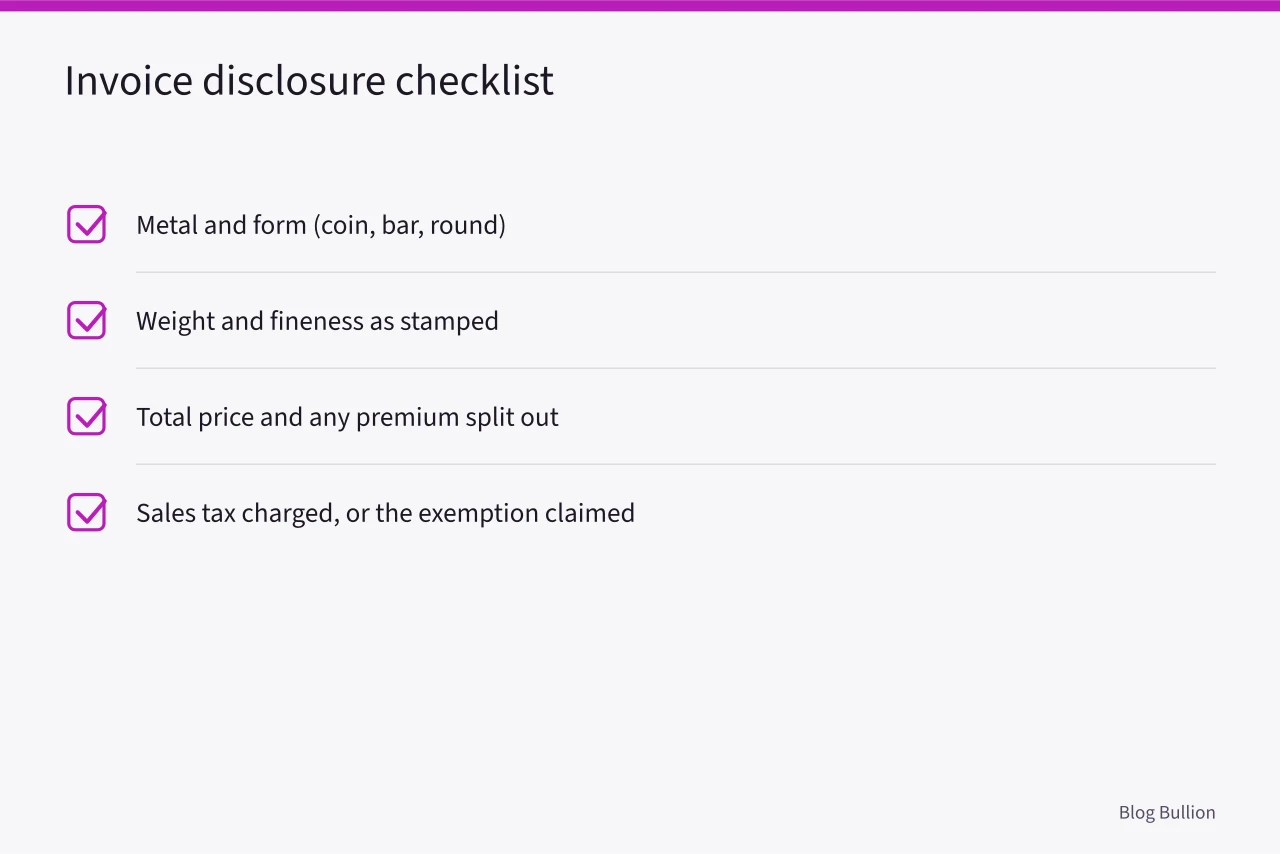
If the seller claims an exemption, the invoice should say so and cite the state. If the sale is taxable, the invoice should show the rate applied and the tax collected. A buyer who cannot tell from the receipt whether tax was charged has no way to check the seller's math later.
- Metal and form (coin, bar, round)
- Weight and fineness as stamped
- Total price and any premium split out
- Sales tax charged, or the exemption claimed
Records to keep
The receipt is the record. Keep it with the coin or bar, not in a shoebox. If you sell later, the same document establishes your basis for capital gains reporting, which is a separate question from sales tax. The IRS instructions for Schedule D explain how proceeds and basis are reported when you dispose of an asset.
Dealers have their own record duties. A dealer that receives more than $10,000 in cash in one transaction, or in related transactions, must file Form 8300. The IRS Publication 1544 covers when that filing is required, including bullion sales.
What happens if you do not
A seller that fails to collect and remit owed sales tax faces assessment of the tax plus interest and penalties, and states can audit several years back. That is the concrete consequence, and it falls on the seller first.
A buyer is exposed mainly through use tax. Most states require a resident to report tax on taxable purchases where no tax was collected. Enforcement on small private purchases is rare, but it is not zero, and it surfaces during audits of other matters.
An exemption claimed wrongly is the sharper risk. If a buyer signs a resale or investment certificate that does not fit the facts, the state can treat the sale as taxable and pursue the party that signed.
Where the rules differ by place
State lines are not the only boundary. Local rates, thresholds and product definitions all move the answer.
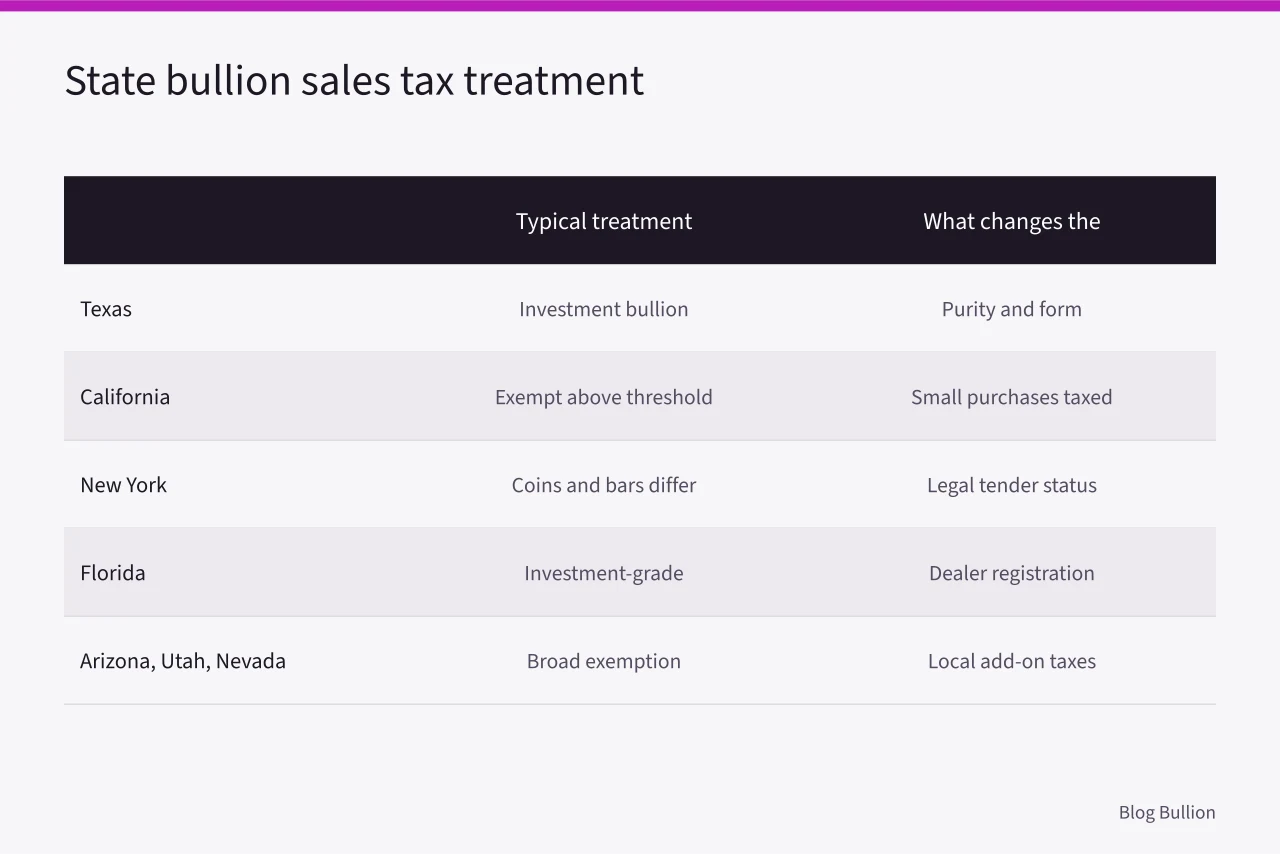
| State | Typical treatment | What changes the answer |
|---|---|---|
| Texas | Investment bullion exempt | Purity and form must meet the statutory definition |
| California | Exempt above a per-transaction threshold | Small purchases fall below it and are taxed |
| New York | Coins and bars treated differently | Whether the item is legal tender |
| Florida | Exempt for investment-grade metal | Dealer registration and documentation |
| Arizona, Utah, Nevada | Broad exemption | Local add-on taxes in some jurisdictions |
For a closer look at four large markets and how their rules interact with dealer practice, see How US sales tax on bullion works across Texas, California, New York and Florida. Buyers near a border should also check the neighboring state before driving to a shop, because the exemption you rely on at home may not travel.
Alaska is a special case worth reading on its own, since it has no state sales tax but shipping and logistics shape the real cost: Buying bullion in Alaska, no sales tax but shipping and logistics hurdles.
Common questions
Does the IRS charge sales tax on gold? No. The IRS administers income and capital gains tax, not sales tax. Federal law does not impose a sales tax on bullion purchases.
Is bullion bought online taxed differently? Usually the same rule applies, based on the buyer's state and the seller's nexus there. Remote sellers now collect in most states following the South Dakota v. Wayfair decision.
Can a dealer waive sales tax if I pay cash? Only where the transaction is genuinely exempt. Cash payment does not create an exemption, and a large cash payment can trigger a Form 8300 filing by the dealer.
Where do I check my own state's rule? Start with your state department of revenue and search its exemption publication for bullion or investment metal. Statutes control, and they change.