Guides
Bullion dealer and marketplace due-diligence guide
Check who legally sells you the metal, what the marketplace actually covers, and which records prove the deal if the bar never arrives at your door.
What to take away
- Identify the legal seller, not the storefront name or the marketplace badge.
- Put the exact product, total price, ship-by date, and return terms in writing before paying.
- Read marketplace exclusions for coins, bullion, local pickup, and off-platform payment.
- Match your payment method to the amount at risk and to how reversible it is.
- Keep the listing, invoice, messages, tracking, and unboxing photos until the metal is verified.
A bullion order stacks product risk on top of counterparty, payment, and delivery risk. A familiar coin says nothing about an unfamiliar seller. The work is deciding who owes what, when each duty starts, and which record proves it was performed.
The Postal Inspection Service's page on mail fraud advises getting every term in writing before you agree to buy, refusing pressure to decide immediately, and checking a company through a state attorney general's office or the FTC. Those checks apply to bullion even when the listing looks routine.
Identify every party
Write down the seller's legal name and trade name. Also write the seller's street address and working phone number. Also write the seller's email domain and state of organization. When a platform hosts the listing, find out its role. Does it take payment, hold funds, authenticate the item, or guarantee delivery? Or does it only introduce buyer and seller?
Party due-diligence checklist
- Seller legal name and trade name
- Street address and working phone
- Email domain and state of organization
- Platform rolepayment, funds, authentication, delivery
- Marketplace exclusions for coins and metals
- Exclusionshigh-value goods, local pickup, off-platform
- Exclusionspayment methods
A marketplace logo is not a promise that your order is covered. Read the exclusions for coins and precious metals. Also read the exclusions for high-value goods, local pickup, off-platform messages, and payment methods.
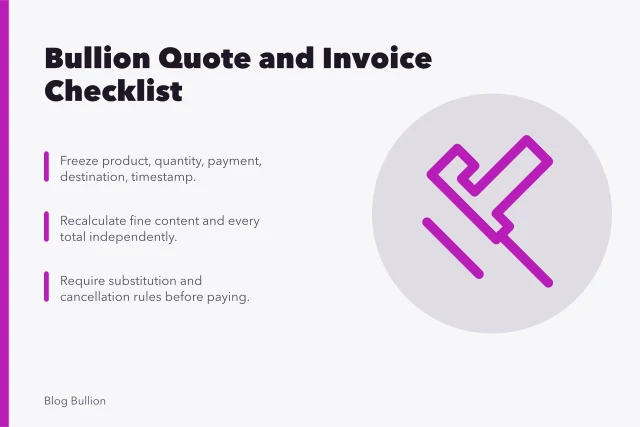
Freeze the product description
Invoice description checklist
- Metal and product type
- Mint or refiner and design
- Denomination or year
- Gross weight, fine content, fineness
- Quantity, package type, condition
- Certification number on graded piece
- Substitution policy
Save the listing as a PDF or a dated screenshot. A page edited next week should not replace the description you bought against.
Price the whole transaction
Total transaction cost checklist
- Merchandise price
- Payment surcharge
- Tax
- Shipping
- Insurance
- Handling
- Storage
- Cancellation charge
Add insurance, handling, storage, and any cancellation charge. Note the price-lock window and the event that binds the order. A dealer may treat an accepted trade as final before your funds land.
Match controls to the payment
Payment methods are not interchangeable. Compare fees, settlement time, reversibility, identity checks, purchase limits, and written dispute rights. The FTC's advice on how to avoid a scam says never to pay someone who insists on cryptocurrency, a wire service, a payment app, or a gift card, and that being told to withdraw cash or buy gold and hand it over is itself a scam. When a wire destination changes, confirm it through a channel you obtained independently.
Specify fulfillment before paying
Ask whether the item is in stock, allocated, presale, or sourced after payment. Get the ship-by date, carrier, service level, and declared value in writing. Also get the signature requirement and package description in writing. Ask who files a carrier claim, and whether you get a refund or a replacement while that claim is open.
Receive with a record
Inspect the outer package before opening it. Photograph every side, the label, the seal, and any puncture or wet area, with a scale in frame. Open on one continuous video when the value justifies it. Keep the packaging until quantity, identity, condition, and authenticity are settled.
Escalate by deadline
Write to the seller first, name the remedy you want, and set a response date. Then use the marketplace, payment provider, carrier, insurer, or regulator process that applies. Calendar every filing window. A long email thread should not eat a formal dispute deadline.
Worked example: a shorted order
You buy five 1 oz silver coins and four arrive. Photograph the sealed box, the packing slip, and the four coins on a scale. Email the seller the same day, ask for the fifth coin or a refund of one-fifth of the merchandise price, and give a response date.
If that date passes, file with the marketplace or payment provider inside its window, and keep the thread as evidence. Do the same arithmetic for a substituted year or a bar that fails a weight check.
Common questions
Does a long business history prove a dealer is safe?
No. It is one signal among several. Current identity, written terms, inventory claims, payment controls, and recent complaint patterns still need review.
Is marketplace checkout always safer than paying the dealer directly?
No. Read the platform's coverage, exclusions, deadlines, and eligible payment methods for that specific listing before you rely on them.
Should I accept a comparable substitute?
Only after you receive the full specification and price in writing and choose to accept it. Silence is not consent.
What is the minimum record to keep?
Keep the listing, invoice, payment proof, and messages.
Keep the tracking, delivery record, package photos, and inspection notes.
Keep any claim documents. Store them together.