Reviews
Part of Precious-metals storage and records guide
Home safe, bank box, and private bullion vault compared
Bullion storage options compared across access, custody, privacy, insurance, evidence, disaster exposure, operating hours, fees, and succession planning.
What to take away
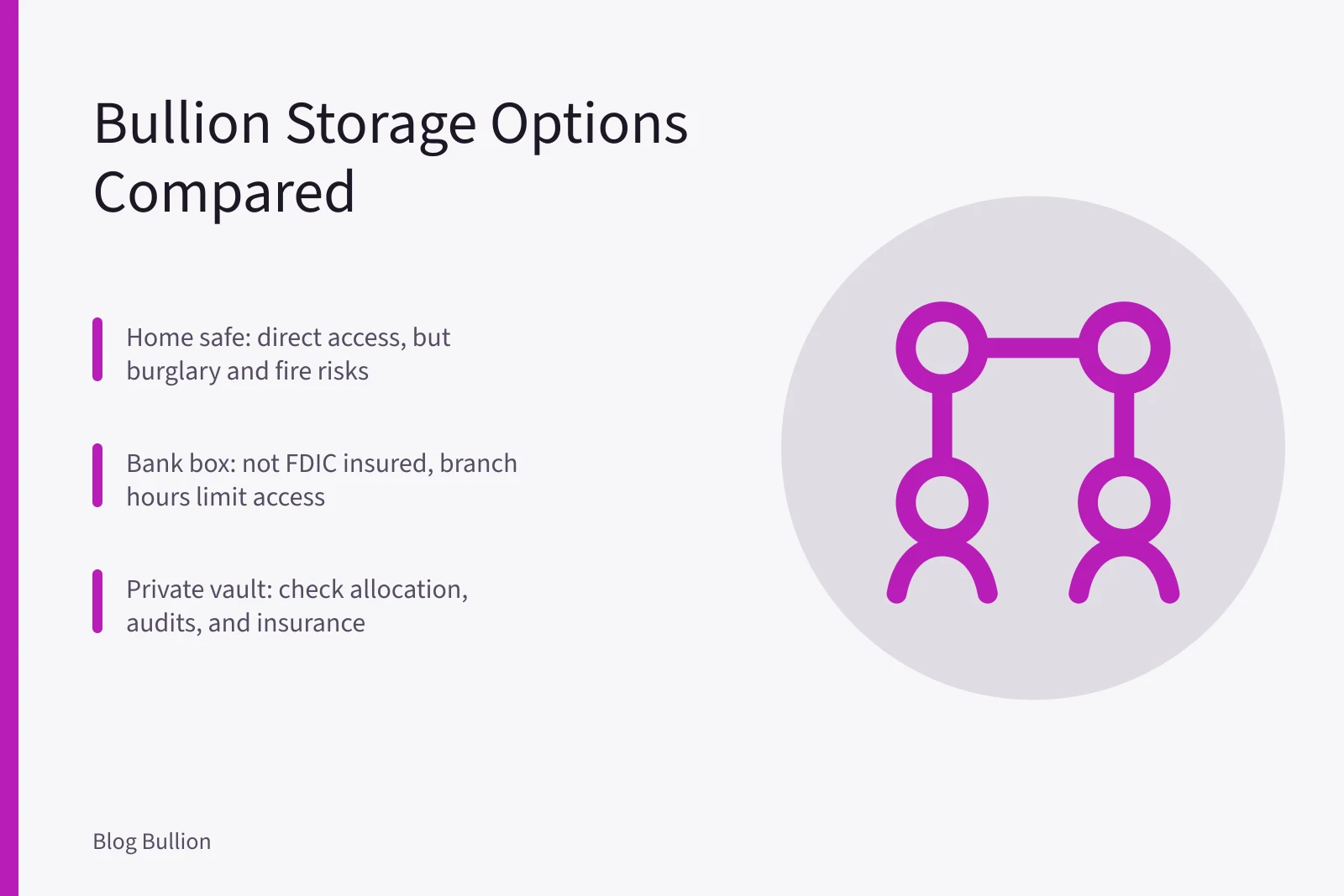
- Home storage offers direct access but concentrates household and security risk.
- A bank box limits access to branch rules and hours and is not an insured deposit.
- A private vault requires close review of allocation, audits, withdrawal, and insurance.
- Split storage reduces one-location concentration but adds movements and records.
- No location solves access, insurance, privacy, and succession by itself.
Compare storage by failure mode and operating terms, not by the thickness of a door in an advertisement.
Side-by-side view
Storage Options Side by Side
Home safe
- Routine access
- Owner-controlled
- Custody
- Owner
- Inventory
- Owner creates
- Privacy
- Household, insurer
- Insurance
- Verify policy
- Succession
- Estate plan
Bank box
- Routine access
- Branch hours
- Custody
- Renter
- Inventory
- Usually owner
- Privacy
- Bank records
- Insurance
- Arrange separately
- Succession
- State law
Private vault
- Routine access
- Contract process
- Custody
- Custodian
- Inventory
- May provide
- Privacy
- Custodian data
- Insurance
- Verify coverage
- Succession
- Contract title
Home safe
- Routine access
- Owner-controlled
- Custody
- Owner
- Inventory service
- Owner creates it
- Privacy exposure
- Household, installer, insurer
- Insurance
- Must verify policy
- Succession
- Household and estate plan
Bank safe deposit box
- Routine access
- Branch hours and authorization
- Custody
- Box renter controls contents within bank facility
- Inventory service
- Usually owner-created
- Privacy exposure
- Bank records box relationship
- Insurance
- Must arrange or confirm separately
- Succession
- State law and bank procedure
Private bullion vault
- Routine access
- Contract and withdrawal process
- Custody
- Custodian holds metal
- Inventory service
- May provide statements or item lists
- Privacy exposure
- Custodian collects identity and account data
- Insurance
- Must verify customer coverage and limits
- Succession
- Contract, account title, and estate procedure
Home safe
Home storage avoids business-hour and withdrawal delays. It also creates burglary, coercion, household access, fire, water, anchoring, and disclosure concerns. A portable container can be removed. A hidden container can become inaccessible after illness or death. Confirm tested ratings, installation needs, location hazards, and insurance requirements.
Bank safe deposit box
The FDIC's five points about bank boxes and home safes says box contents are not covered by FDIC deposit insurance, access may be unavailable outside bank hours, and authorized co-renters may have unrestricted access. It also recommends reading the rental agreement and considering separate insurance.
Ask about permitted contents, key loss, drilling costs, unpaid rent, branch closure, access logs, joint renters, agents, disability, death, and state unclaimed-property rules. Keep ownership evidence outside the box as well as protected copies inside when appropriate.
Private bullion vault
The phrase private vault describes many arrangements. Determine the legal custodian, actual storage site, allocation method, item identification, subcustodians, audits, customer inspection, withdrawal form, minimums, fees, liens, insurance, geographic transfers, and termination process.
An account statement is not the same as a bar list, and a pooled claim is not the same as custody of identified items. Read whether the customer owns specific metal or has a contractual claim against a business.
Access controls differ
Bank supervisory guidance covers safe-deposit controls: dual control, authorized signatures, access logs, and contract disclosures. The Office of the Comptroller of the Currency's handbook on safe deposit services says banks do not insure box contents against loss.
It also discusses when a bank may open a box. The handbook guides banks; the customer's signed agreement and state law govern the individual arrangement.
Split storage
Two locations may reduce a single fire, theft, or access interruption. It can also double fees, travel, inventories, keys, authorizations, and transfer risk. Use neutral location codes and reconcile after every movement.
Decision worksheet
Score each candidate on access time, theft exposure, fire and water controls, insurance proof, privacy, custody evidence, emergency authority, exit time, and annual cost. Reject any option whose contract cannot answer a required question.
Common questions
Are safe deposit box contents insured by the FDIC?
No. FDIC deposit insurance applies to qualifying deposits, not box contents.
Is private-vault insurance enough by itself?
Not without reading the insured party, property, events, exclusions, limits, deductible, and claims procedure.
Should original invoices be stored with the metal?
Keep protected evidence in another loss zone so one event does not destroy both property and proof.
Does split storage always reduce risk?
No. It trades concentration risk for more access points, movements, and administrative work.