Rules
Part of Precious-metals storage and records guide
Lost records, water damage, theft, and bullion access problems
Bullion storage problems guide for missing records, water exposure, suspected theft, lockouts, custodian interruption, insurance evidence, and controlled recovery.
What to take away
- Protect people and the scene before moving property.
- Reconstruct missing records from independent counterparties and custody evidence.
- Separate wet documents from wet metal and package materials.
- Report suspected theft precisely and preserve access logs.
- Do not defeat a lock or custodian process without lawful authority.
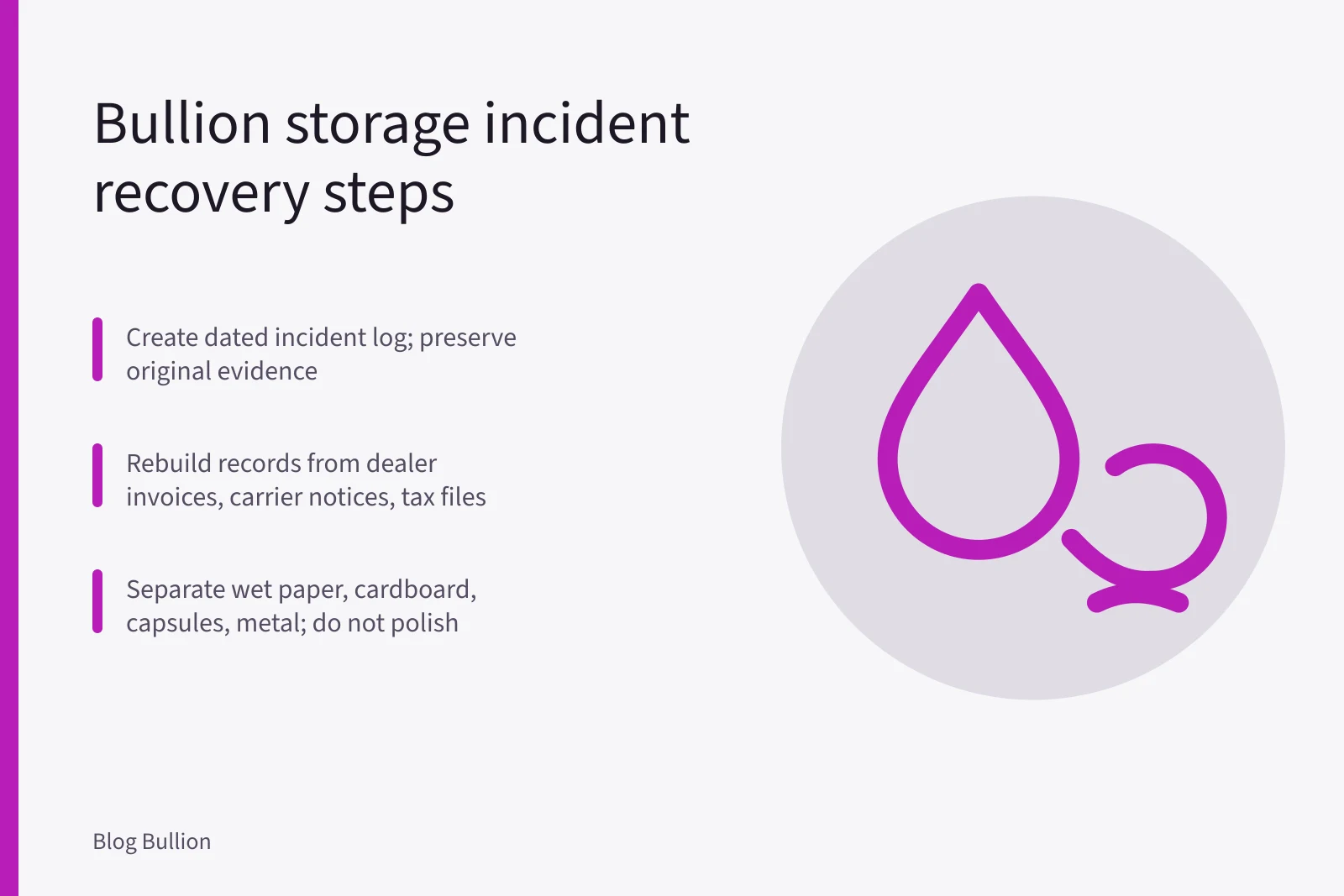
A storage problem can affect property, proof, access, and insurance at once. Create a dated incident log, preserve original evidence, and avoid irreversible cleaning or repair until the relevant expert or insurer gives instructions.
Missing records
Start with the last verified inventory. Rebuild the timeline from dealer invoices, payment records, carrier notices, emails, tax files, grading records, custodian statements, photographs, and prior insurance schedules. Mark each recovered fact by source. Do not invent serials or acquisition dates to fill blanks.
Rebuild inventory from records
- Dealer invoices
- Payment records
- Carrier notices
- Emails
- Tax files
- Grading records
- Custodian statements
Where a card or account is caught up in the loss, the reporting discipline is the same. FTC advice on lost or stolen cards says to report the loss to the issuing bank or credit union as soon as possible.
Follow up immediately in writing with the account number and the date and time the loss was noticed and first reported, and keep a copy of that letter along with notes from every call. Build the metal side of the file the same way: dated, written, and kept.
Water exposure
First address electrical, structural, sewage, chemical, and mold hazards. Photograph the area before moving items when safe. Record which containers were submerged, splashed, or exposed to humidity.
Do not assume a safe is waterproof because it resists fire. Open it only when safe and authorized. Separate wet paper, cardboard, capsules, and metal without scraping surfaces. Do not polish coins or discard branded packaging before condition and insurance needs are understood.
Suspected theft
Limit further access and preserve locks, camera footage, alarm events, access logs, messages, and inventory records. Count with a witness and note exactly what is missing. Report facts rather than naming a suspect without evidence. Obtain the incident or police report number and notify the insurer within the required time.
Provide a redacted inventory where possible. A public or widely circulated report does not need to reveal the location of remaining holdings.
Lockout or lost credentials
Identify whether the barrier is a home safe, bank box, encrypted file, or custodian account. Use the manufacturer, bank, provider, court, fiduciary, or recovery process that applies. Preserve proof of ownership and authority. Avoid repeated code attempts that could trigger a lockout or data wipe.
Custodian or branch interruption
Save the contract, latest statement, item list, payment record, and all notices. Verify any new contact or payment instruction independently. Ask where physical property is located, whether customer access continues, and which regulator or receiver controls the next step.
Claim evidence gaps
Wisconsin's Office of the Commissioner of Insurance states in its personal property home inventory fact sheet that a homeowner policy covers valuable items such as jewelry, furs, art, and antiques only up to set dollar amounts. Scheduled personal property coverage may be needed beyond them.
The fact sheet also says an inventory should keep a detailed record of collector's items, copy serial numbers, and be kept somewhere other than the home. If a loss reveals that a policy schedule is stale, submit truthful existing records and ask what substitute proof the adjuster accepts. Do not recreate a false pre-loss appraisal.
Recovery log
| Time | Event | Person | Evidence preserved | Next action |
|---|---|---|---|---|
| Discovery | ||||
| Safety check | ||||
| Inventory count | ||||
| Notice to insurer or custodian | ||||
| Recovery or claim decision |
Common questions
Should wet coins be polished immediately?
No. Stabilize the situation and obtain appropriate conservation or product guidance before changing surfaces.
What if the inventory and physical count disagree?
Freeze movements, repeat the count with a witness, review access and transfer logs, and record the unresolved variance.
Can a locksmith open any safe for an heir?
The heir must establish ownership and legal authority, and the safe or facility procedure must be followed.
Should all records be given to the police or insurer?
Provide what is required and relevant. Keep originals, send copies, and redact unrelated sensitive information when allowed.