Features
Part of Bullion dealer and marketplace due-diligence guide
Case study: resolving an online bullion order dispute
Online bullion dispute case showing how a buyer documented delay, rejected a product substitution, preserved card rights, and reconciled a complete refund.
What to take away
- A precise invoice made the substitution easy to identify.
- The buyer separated shipment delay, product mismatch, and payment rights.
- Written notices used facts and requested one clear remedy.
- The payment deadline was calculated from the card statement.
- Refund reconciliation closed the case without double recovery.
This fictional case illustrates a documentation method. It is not legal or financial advice, and the figures do not represent a current bullion price.
The order
Mara ordered ten specified one-ounce silver coins from an online dealer for a fictional delivered total of $390. The invoice named the mint, year, quantity, package condition, card payment, and a five-business-day shipping promise. She saved the listing, terms, invoice, and card authorization in one folder.
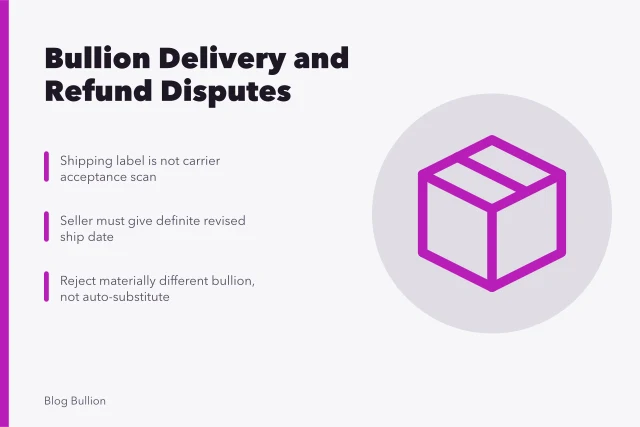
On business day six, tracking showed only that a label had been created. The seller said the named year was unavailable and offered ten random-year coins without a price adjustment. Mara did not agree. She requested either the invoiced product by a stated date or cancellation and a full refund.
The evidence timeline
| Day | Event | Record |
|---|---|---|
| 0 | Order accepted | Listing, invoice, payment receipt |
| 5 | Promised ship period ended | Saved terms and empty tracking history |
| 6 | Substitute offered | Dealer email |
| 6 | Buyer declined | Written remedy request |
| 9 | No refund trace supplied | Follow-up email |
| 11 | Card statement issued | Statement copy and deadline note |
| 13 | Written card notice sent | Certified-mail receipt and copy |
| 18 | Seller refunded | Processor confirmation |
| 21 | Credit posted | Card statement activity |
Why the product difference mattered
The invoice did not say random year. The offered coins matched the stated fine silver quantity, but year, condition expectations, and resale recognition could differ.
Invoiced coins vs offered substitute
Invoiced product
- Year
- Named year
- Condition
- Stated expectation
- Resale recognition
- Recognized
- Price
- $390 total
Offered substitute
- Year
- Random year
- Condition
- Could differ
- Resale recognition
- Could differ
- Price
- No adjustment
Mara avoided arguing about motive or value. She wrote the product did not match invoice 1842's year, rejected the substitution, and asked to cancel and return the full $390 to the card used.
FTC consumer advice on an online order that never arrives says sellers must ship when they or their ads say they will. When they do not, they must tell the buyer and allow a cancel for a full refund.
If no shipping date was given, sellers have 30 days from the order date. Mara worked from that timing rule, not the seller's assurances.
Preserving the payment track
Mara called the issuer, then sent a written notice to the designated billing-inquiry address. She identified the account, charge, amount, date, seller, reason, and prior attempt to resolve it. She kept the mailing proof.
Her notice did not depend on a phone call alone. It included copies of the invoice, the five-day shipping term, tracking with no acceptance scan, the substitution offer, and her rejection. She sent copies rather than originals and redacted unrelated transactions. A calendar entry recorded the issuer's expected acknowledgment and investigation dates.
She also checked the marketplace terms, but the order had been placed directly with the dealer, so no platform process applied. This kept the file focused on the contract and the card procedure that governed the payment.
The Consumer Financial Protection Bureau explains that charging for goods not received or not accepted can qualify as a billing error and discusses the 60-day written-notice period measured from the statement on which the charge appeared. Mara used her real statement date rather than guessing from order day.
Closing the case
The seller processed a full refund before the issuer completed its investigation. Mara notified the issuer, supplied the credit evidence, and confirmed that merchandise had not shipped. She reconciled the original charge and posted credit, then saved the final statement and closure message.
No carrier claim was filed because no acceptance scan showed carrier custody. No claim of counterfeiting was made because no product arrived. Keeping those issues separate made the request easier to verify.
What would change the response?
- If the package had entered transit, carrier evidence and claim ownership would matter.
- If Mara had accepted the substitute, the dispute would concern the accepted agreement.
- If payment had been wired, card billing-error procedures would not apply.
- If the refund were partial, she would reconcile each omitted charge before replying.
Common questions
Why did Mara reject the substitute in writing?
The message created a dated record that she had not accepted a different product.
Why was the statement date important?
The cited card procedure measures its written-notice period from the statement, not simply from purchase day.
Could she keep both a refund and a dispute credit?
No. She reported the seller refund so the account could be reconciled without duplicate recovery.
Why was there no carrier case?
The evidence showed label creation but no carrier acceptance, so the issue remained with seller fulfillment.