Rules
Part of Bullion pricing guide: spot, premium, spread, and fees
Bullion pricing problems: stale spot feeds, hidden fees and misleading discounts
Bullion pricing problems, from stale spot feeds to hidden fees and misleading discounts, and the comparison basis that exposes each one before you pay.
What to take away
- A price without provider, timestamp, delay, unit and metal is not a reference, it is a number.
- Checkout quantity, payment method and destination can each move the premium after the page loads.
- "Below market" means nothing until the market and the exact product are named.
- An ask without a matching bid hides the round trip, which is where most of the cost sits.
- Save the screen, the invoice and the clock time before you dispute anything.
A stale feed beside a live ask
The reference freezes while the dealer keeps repricing the product. The premium shown on the page is then arithmetic on a dead number, and it looks better or worse than the real one.
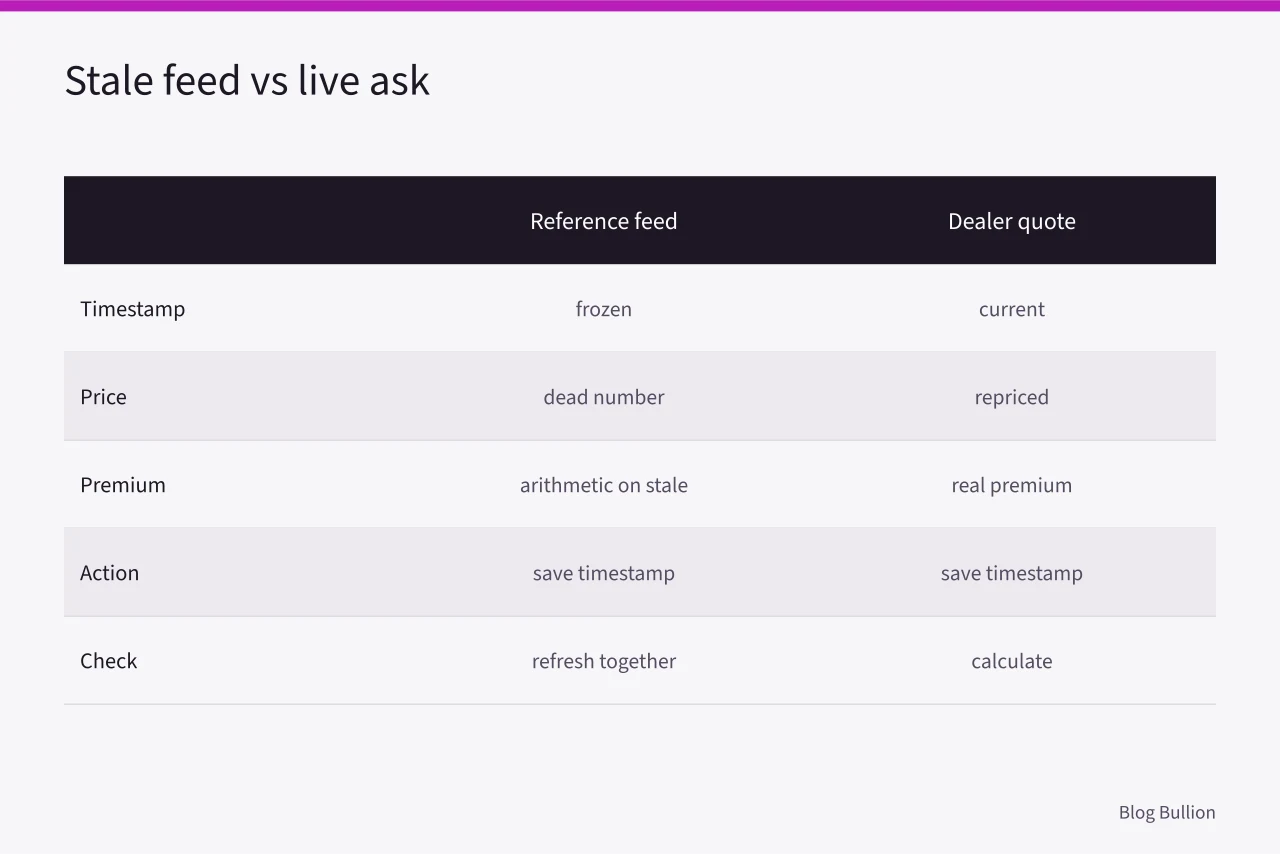
Save both timestamps. Refresh the reference and the quote together, then calculate from one independent source. If the two clocks disagree by more than the feed's stated delay, the premium is unknown.
Futures are not spot
Futures and spot differ by delivery time, financing and location. The CFTC's explanation of the economic purpose of futures markets describes standardized contract terms: size, delivery months, delivery locations, and acceptable grades, with different grades deliverable at fixed premiums or discounts. Delivery exists so the futures price converges with the cash price.
A retail coin quote is neither contract. It is also not the cash price the exchange converges toward. Name the instrument and the delivery basis before you compare anything.
The tier you are not buying
A page advertises the 500-unit premium while the cart holds one coin. The headline number belongs to a quantity you did not order.
Record the tier that applies to your actual quantity, then compute delivered cost at that tier. The gap between the advertised tier and yours is often wider than the spread between two dealers.
Payment method changes the price late
A card fee appears after you enter details, or the wire discount quietly disappears. Select the payment method first, then read the final authorization total. If the total moves for a reason nobody will explain, abandon the order.
Free shipping with paid insurance
Handling, insurance and signature charges surface as separate lines. Add every unavoidable charge. A marketing label does not change cash leaving your account.
The crossed-out price
That comparison price may never have applied to this product, quantity or payment method. The FTC's guide to advertising and marketing basics states that ad claims should be truthful, non-deceptive and evidence-based. It does not settle an individual bullion dispute, but it supports asking a dealer for the real basis of a savings claim.
Ignore the crossed-out figure. Compare current delivered asks against current net bids.
"At spot" and the product behind it
The item may be random brand, damaged packaging, mixed year, or a larger unit than you pictured. Identify the exact deliverable and its condition. A low price is not a bargain if the exit is worse than the entry.
The buyback formula with deductions
The seller quotes spot, then subtracts assay, shipping or handling at settlement. Ask for a worked net example before you buy, and price the same metal with an independent buyer.
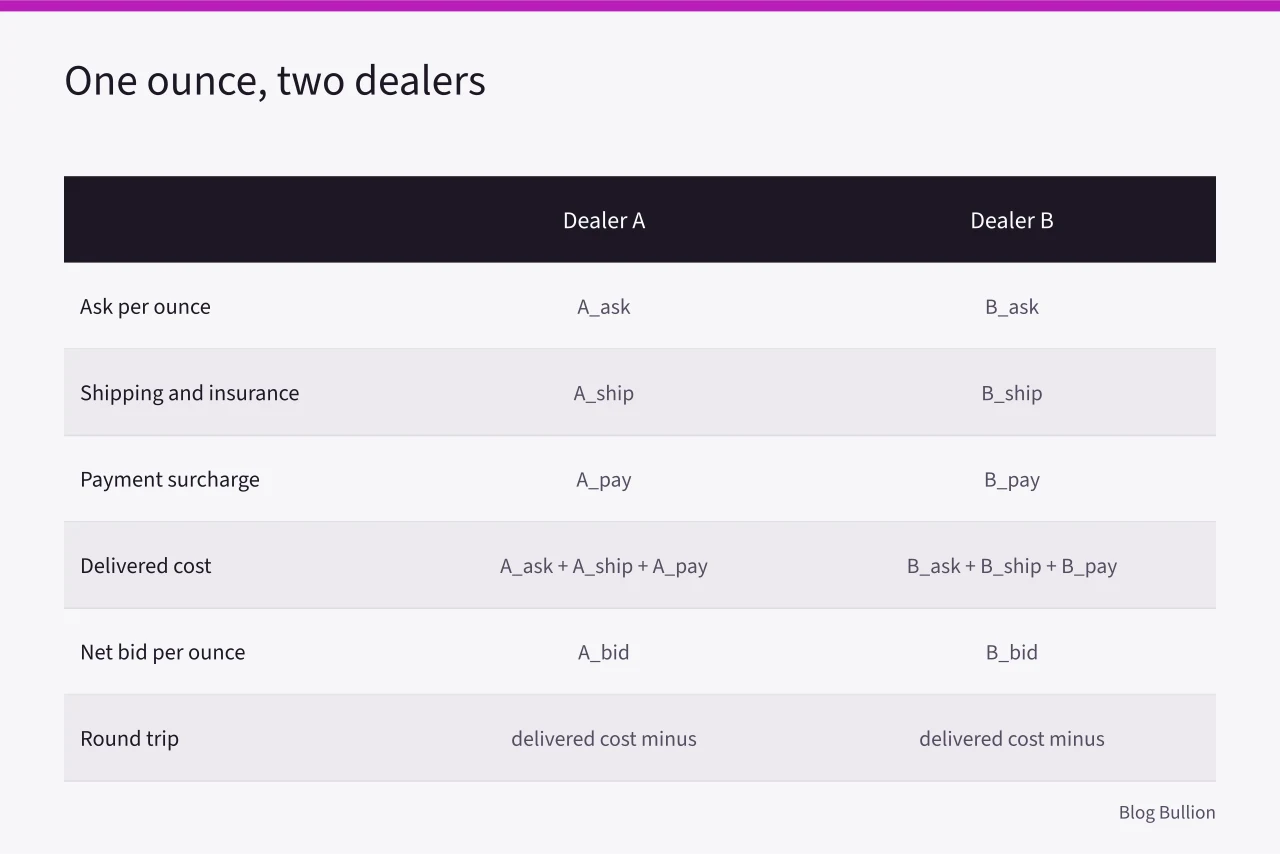
Worked example: one ounce, two dealers
Substitute your own figures. The point is the shape of the arithmetic, not the numbers.
| Line | Dealer A | Dealer B |
|---|---|---|
| Ask per ounce | A_ask | B_ask |
| Shipping and insurance | A_ship | B_ship |
| Payment surcharge | A_pay | B_pay |
| Delivered cost | A_ask + A_ship + A_pay | B_ask + B_ship + B_pay |
| Net bid per ounce | A_bid | B_bid |
| Round trip | delivered cost minus A_bid | delivered cost minus B_bid |
The dealer with the lower ask often loses on the round trip. Fill the table with quotes taken at one timestamp from one reference, and the comparison stops being an argument about whose page looked cheaper.
A market pause nobody announces
The dealer still accepts orders while suspending bids or stretching shipping during volatility. Check both sides and the fulfillment status. An active checkout is not evidence of liquidity.
Two sides priced against different references
A seller can build its ask from one feed and its buyback from another, or from the same feed at a different moment. The pair then looks matched and is not.
Ask which provider, metal, unit, currency and time basis each side uses. If the seller will not state both, treat the pair as unpriced rather than assuming they agree.
Build one comparison basis
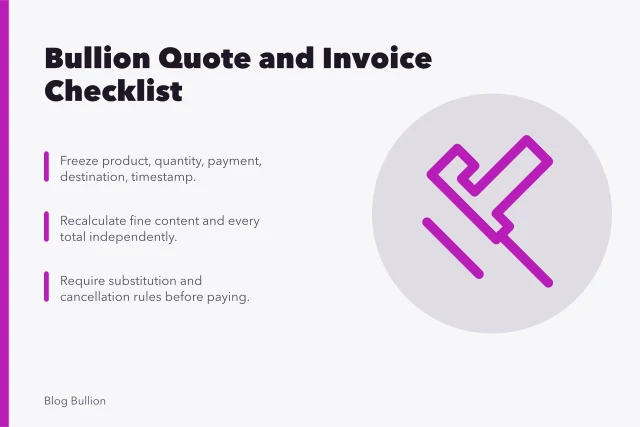
Fix the product, quantity, payment method and destination first. Take every quote against one timestamp from one independent reference. Recalculate the delivered total outside the seller's cart, one charge per line, and write the reference provider and its stated delay next to the result.
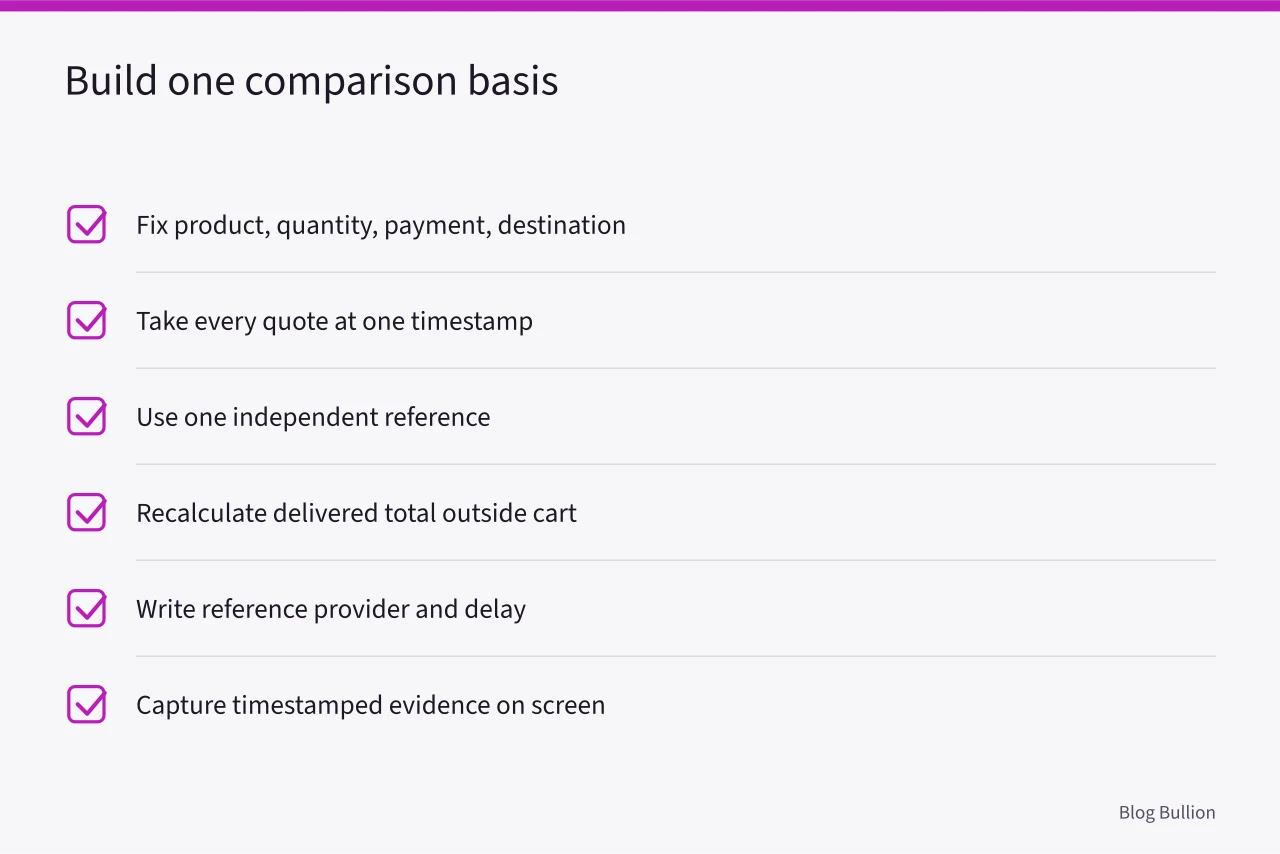
Capture the evidence while it is on screen. A timestamped record of the ask, the reference and the final authorization total outweighs an accurate memory of them, and it costs nothing at the moment of purchase.
Common questions
Is a delayed feed unusable?
No, if it is clearly labeled and every quote in the comparison shares that time basis. It is unsuitable for a live comparison otherwise.
Does "lowest price" include fees?
Only if the claim defines the product, quantity, payment method, destination and every charge. Without those, the claim is not checkable.
Can a dealer change the price before payment?
Terms may allow it. Know when the price locks and what cancellation costs before you authorize anything.
What evidence supports a dispute?
Timestamped screens of the ask and the reference, the terms, the invoice, the authorization total, and the written communications. Keep them together.